
We also offer
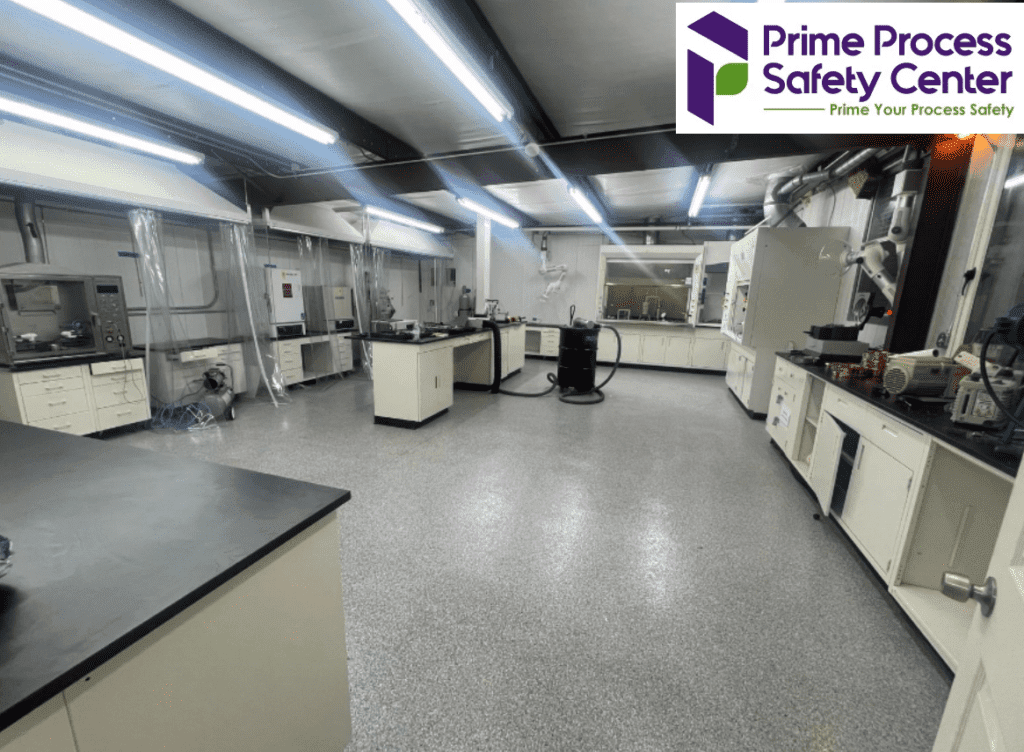
At Prime Process Safety Center, our testing capabilities support a wide range of industries in identifying, evaluating, and mitigating process safety hazards. We specialize in combustible dust testing, reactive chemical testing, UN/DOT testing and classification, gas and vapor flammability testing, and more—helping clients meet regulatory requirements and operate safely.
Our laboratory is equipped with advanced instrumentation and staffed by experienced professionals who deliver accurate, reliable data. Whether you need to assess fire and explosion risks, develop Safety Data Sheets (SDS), or ensure proper classification for transport, we provide the technical expertise and regulatory insight needed to support your process safety goals.
How To Choose the Right Process Safety Laboratory Tests
Start with the material and how your facility uses it. A powder transferred through a dust collector raises different questions from a liquid heated in a mixing vessel. The test plan should reflect the material’s form, composition, particle characteristics, and relevant process conditions, not simply its name on a safety data sheet.
Describe how the material is stored and handled, and any changes in temperature or particle size during production. Share existing test reports and safety data sheets. These records help identify what is already known and where further evidence may be needed. A safety data sheet is a useful starting point, but it may not include the measurements needed for a process-specific hazard evaluation. Discuss the findings with a process safety consultant who can relate the data to equipment and operating conditions. Prime Process Safety Center provides process safety laboratory testing to support material hazard evaluations and facility-specific safety decisions. Test results are one part of that assessment; they do not, on their own, establish that a process is safe.
Laboratory testing prices and quotations
Testing costs vary with the work involved. A single flash point determination has different requirements from a project involving several dust explosibility or chemical reaction tests. Sample preparation, specialist handling and reporting requirements can also affect the final price. We review each inquiry to define a suitable testing scope before confirming pricing. Customers can discuss their materials and available documentation with the team to understand the proposed work and associated costs before proceeding.
Contact us today to discuss your material and request a testing quote.
| DUST TESTING |
| Percent Combustible Product |
| Go / No Go – Explosibility Screening Test |
| Explosion Severity (Kst) Test |
| Explosion Severity (Kst) Test – at elevated temperature |
| Explosion Severity (Kst) Test – at reduced oxygen concentration |
| Explosion Severity (Kst) Test – Hybrid Mixture |
| Minimum Ignition Energy Test – Dust Cloud |
| Minimum Ignition Temperature Test – Dust Cloud |
| Minimum Ignition Temperature Test – Dust Layer |
| Limiting Oxygen Concentration – 20L Sphere |
| Particle Sieve Analysis |
| Sample Disposal Fee (minimum per sample) |
| Grinding and particle size reduction |
| ELECTROSTATIC TESTING – LIQUIDS |
| Liquid Conductivity Test |
| Electrostatic Chargeability Test – Liquid |
| Electrostatic Chargeability Test – Spray |
| ELECTROSTATIC TESTING – POWDERS |
| Volume Resistivity & Charge Relaxation Time- Powder |
| Volume Resistivity-Powder |
| Electrostatic Chargeability Test – Powder |
| FILMS, FABRICS, LINERS, SHOES, GLOVES, CLOTHING, & FLOORING SAMPLES |
| Volume Resistivity & Charge Relaxation – Sheets, Films, Fabrics, Foils |
| Surface Resistivity & Charge Relaxation – Sheets, Films, Fabrics, Foils |
| Propagating Brush Discharge Testing & Breakdown Voltage Measurement |
| Electrostatic Discharge Testing |
| Measurement of Electr. Resistance – Shoes, Gloves, Clothing, & Flooring |
| ELECTROSTATIC TESTING – FIBCs, DRUMS, SACKS |
| Measurement of Resistance to Ground – FIBC |
| Volume Resistivity & Charge Relaxation Time – Drum/Sack |
| Surface Resistivity & Charge Relaxation Time – Drum/Sack |
| Electrostatic Chargeability Test – Drum/Sack |
| Electrostatic Chargeability Test – Emptying of Drum/Sack |
| Electrostatic Chargeability & Discharge Incendivity Test – Drums/Sacks |
| OTHER TRANSPORTATION TESTS |
| Sustained Combustibility Test – DOT/UN Test L.2 or ASTM D4206-96 |
| Burning Rate Test – DOT/UN Test N.1 (Division 4.1) |
| Self-Heating Substances Test – DOT/UN Test N.4 (Division 4.2) |
| PHYSICAL PROPERTY DETERMINATION |
| Melting Point |
| Boiling Point |
| Glass Transition Temperature (using DSC) |
| Density/Specific Gravity |
| Vapor Pressure – ASTM D2879 |
| Surface Tension (Soluble) |
| Surface Tension (Insoluble) |
| Water Solubility |
| Partition Coefficient |
| Specific Heat Capacity – DSC |
| Heat of Combustion |
| Heat of Vaporization |
| FLAMMABILITY TESTING |
| Open Burning Test – Liquids |
| Flash Point Test – Cleveland Open Cup |
| Fire Point Test – Cleveland Open Cup |
| Flash Point Test – Closed Cup |
| Flash Ignition Temperature |
| Spontaneous Ignition Temperature |
| Explosion Severity (Kg) – Vapors & Gases |
| Explosion Severity (Kg) – Vapors & Gases – at high pressure |
| Explosion Severity (Kg)-Vapors & Gases-at reduced oxygen concentration |
| Explosion Severity (Kg) – Hybrid Mixture |
| Explosion Severity (Pm and Kg Testing) – Gas/Vapor (atmospheric pressure) |
| Limits of Flammability – per ASTM E-681 |
| Limits of Flammability – at high pressure |
| Limits of Flammability – higher than 50 psig and/or greater than 150°C |
| Flammability Diagram – per ASTM E-681 |
| Flammability Diagram – at high pressure |
| Flammability Diagram – higher than 60 psig and/or greater than 150°C |
| Autoignition Temperature – per ASTM E-659 |
| Autoignition Temperature – at high pressure |
| Autoignition Temperature Determination per ASTM G72 |
| Limiting Oxygen Concentration – per ASTM E-2079 |
| Limiting Oxygen Concentration – at high pressure |
| Limiting Oxygen Concentration – higher than 60 psig and/or greater than 150°C |
| SADT-Self-accelerating Decomposition Temp.-Adiabatic Storage (UN H.2) |
| SADT-Heat Accumulation Storage (UN H.4) – First Test |
| Temperature Limit of Flammability ASTM E-1232 |
| Temperature Limit of Flammability in Pure or Reduced Oxygen |
| Flame Projection Test ASTM D3065 – Flammability of Aerosols |
| Ignition Distance Test UN DOT Standard – Flammability of Aerosols |
| Aerosol Foam Test – per UN DOT Standard |
| Flammability Rating per ASTM D 6668 |
| THERMAL INSTABILITY TESTING |
| Preliminary Screening Test for Flammability – Needs to be done for Safety |
| Powder Layer Screening Test |
| Bulk Solids Screening Test – Powder |
| Isothermal Bulk Powder Test |
| Aerated Powder Screening Test |
| Isothermal Aerated Powder Test |
| Isothermal Powder Layer Test |
| Isothermal Test – Basket Test |
| CHEMICAL REACTION HAZARD TESTING |
| Desk Screening for Chemical Reaction Hazards Using CHETAH |
| Substance Instability Assessment |
| Differential Scanning Calorimetry – Dynamic (LP Cell) |
| Differential Scanning Calorimetry – Dynamic (HP Cell) |
| Differential Scanning Calorimetry – Dynamic (HP Cell) Cryogenic |
| Differential Scanning Calorimetry-Isothermal(LP Cell) |
| Differential Scanning Calorimetry – Isothermal(HP Cell) |
| Thermogravimetric Analysis (TGA) – Dynamic (Standard Cell) |
| Thermogravimetric Analysis (TGA) – Isothermal (Standard Cell) |
| Reaction Hazard Screening Testing Package (Carius/DSC) |
| Accelerating Rate Calorimetry (ARC) |
| Vent Sizing Package Test (normal conditions) |
| Water Solubility (Pricing to vary based on the sample) |
| pH Measurement |
Frequently Asked Questions
1. What does process safety laboratory testing establish?
It measures material properties. Results inform hazard evaluations but do not replace review of a facility’s equipment and operating conditions.
2. Can a safety data sheet provide everything needed?
Not always. Safety data sheets may omit data on minimum ignition energy, dust explosibility, thermal stability, or electrostatic sensitivity. Required information depends on the material and process.
3. Should a material be retested after a supplier or formulation change?
Review the change before relying on results. Composition or moisture differences can affect material behavior. A laboratory can assess whether existing data remains relevant.
4. What should I send when requesting a quote?
Provide the material’s identity and composition, intended use, known hazards, safety documents, and the questions testing should answer. The laboratory can advise on sample requirements and methods.
5. Does one test cover every process hazard?
No. Each method measures specific properties. A material may need several tests, and you should consider results alongside site conditions.
6. How long will testing take?
Timing depends on the methods and laboratory schedule. Ask for an estimate when the scope is reviewed.