
We also offer
Flammability Testing Services
Turn laboratory data into defensible fire and explosion risk controls
A practical guide to flash point, flammability limits, autoignition temperature, limiting oxygen concentration, explosion severity, minimum ignition energy, vapor pressure, and burning velocity.
Why flammability data must match the process
A liquid, gas, or vapor is not simply “flammable” or “nonflammable.” Its behavior depends on the system around it. Temperature affects vapor generation and flame propagation. Pressure can change the range over which a mixture burns. Oxygen enrichment can expand the flammable region, while nitrogen, carbon dioxide, steam, or another inert gas can narrow it. Vessel geometry, ignition energy, turbulence, and test method can also influence the measured result.
That is why handbook values or a supplier safety data sheet may be useful for screening but insufficient for detailed engineering. Published data may reflect room temperature, atmospheric pressure, pure material, or a different test apparatus. Real processes may involve heated solvents, blended vapors, recycled gas, oxygen-deficient or oxygen-enriched atmospheres, elevated pressure, or changing composition during startup, upset, cleaning, drying, and shutdown.
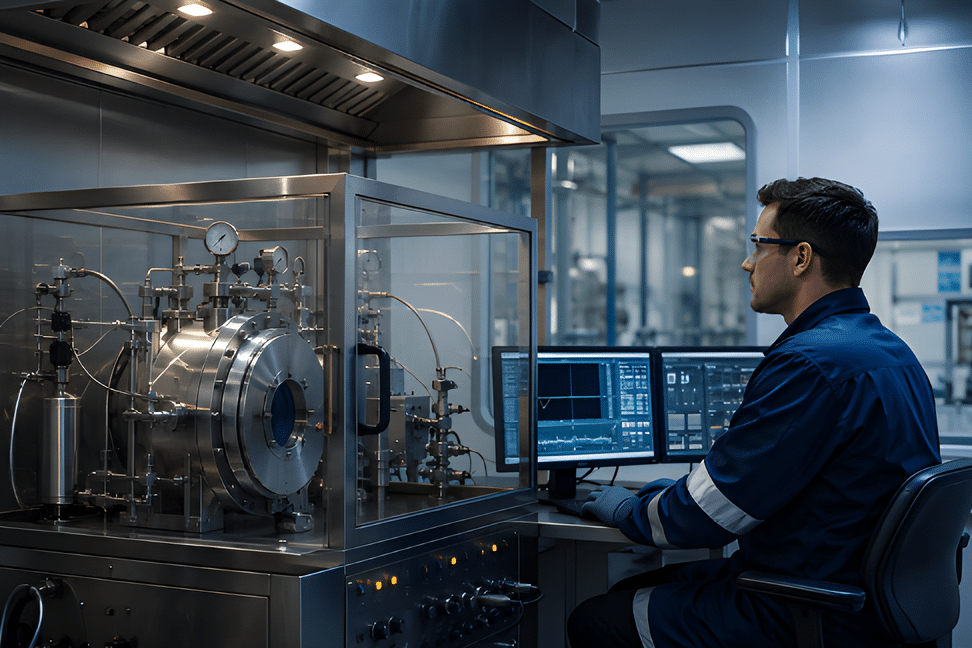
Prime Process Safety Center’s gas and vapor flammability testing services are designed to characterize materials under recognized standard conditions and, where technically appropriate, under representative process conditions. The goal is not only a test value; it is usable evidence for ventilation, inerting, ignition control, hazardous area classification, relief design, operating limits, and emergency planning.
What can happen when data are incomplete
- A heated liquid generates enough vapor to enter the flammable range even though its ambient-temperature behavior appeared acceptable.
- A nitrogen-inerted vessel is operated above the oxygen concentration required to prevent flame propagation.
- Electrical or mechanical equipment is selected without understanding where flammable atmospheres can occur.
- An electrostatic discharge, hot surface, or frictional spark supplies enough energy to ignite the mixture.
- Explosion protection is based on generic severity data that do not represent the actual vapor composition or operating condition.
- A formulation, solvent substitution, scale-up, or higher operating temperature changes the hazard without triggering new testing.
Core flammability testing services
A complete program is built around the decisions the data must support. The following tests are frequently combined because no single measurement describes every aspect of ignition, propagation, and consequence.
| Test | What it measures | How the result is used |
|---|---|---|
| Flash Point | Lowest liquid temperature at which sufficient vapor is produced to ignite momentarily under specified conditions. | Screening and classification of liquid fire hazard; storage, handling, transportation, SDS support, and selection of safe operating temperatures. |
| Flammability Limits (LFL/UFL or LEL/UEL) | Lowest and highest fuel concentrations in an oxidant that support flame propagation under the test conditions. | Ventilation targets, gas detection alarms, purge strategy, operating envelopes, and assessment of releases or enclosed spaces. |
| Autoignition Temperature (AIT) | Lowest temperature at which the material ignites without an external spark or flame under the specified method. | Hot-surface control, heater and equipment temperature limits, storage/handling guidance, and temperature-class considerations. |
| Limiting Oxygen Concentration (LOC) | Highest oxygen concentration below which a flame will not propagate for the tested fuel/inert system under specified conditions. | Design and verification of nitrogen or other inert-gas systems, oxygen alarms, purge procedures, and safe operating margins. |
| Explosion Severity (Pmax and Kg) | Maximum explosion pressure and normalized maximum rate of pressure rise for a gas/vapor mixture in a specified vessel. | Explosion-resistant design, venting or suppression evaluation, consequence assessment, and building/equipment protection strategy. |
| Minimum Ignition Energy (MIE) | Lowest capacitive spark energy that ignites a mixture under the selected test conditions. | Electrostatic ignition risk, bonding/grounding programs, material transfer controls, and evaluation of low-energy ignition sources. |
| Vapor Pressure | Equilibrium pressure exerted by vapor above a liquid at a specified temperature. | Estimating vapor generation, emissions, release behavior, exposure potential, and whether a flammable mixture can develop. |
| Burning Velocity | Rate at which a flame front travels through an unburned mixture; ISO 817 is commonly applied for refrigerants and ASHRAE 34-related evaluation. | Refrigerant classification, flame-propagation behavior, equipment design inputs, and comparison of formulations. |
1. Limiting Oxygen Concentration: designing inerting systems
LOC testing determines the oxygen threshold below which the tested mixture will not sustain flame propagation. It is particularly important for reactors, dryers, centrifuges, mills, tanks, vapor recovery systems, and other enclosed equipment where air can be displaced by an inert gas. Because the value depends on the fuel, inert gas, temperature, pressure, and method, the result should match the intended service as closely as practical.
The measured LOC is not normally used as the operating setpoint. Engineers apply an appropriate safety margin and consider analyzer uncertainty, sample location, mixing, air ingress, instrument response, startup and shutdown dynamics, loss of inert-gas supply, and credible deviations. The resulting control strategy may include continuous oxygen monitoring, alarms and interlocks, pre-purge requirements, emergency inerting, and proof testing.
2. Flash Point: identifying when a liquid can create an ignitable vapor
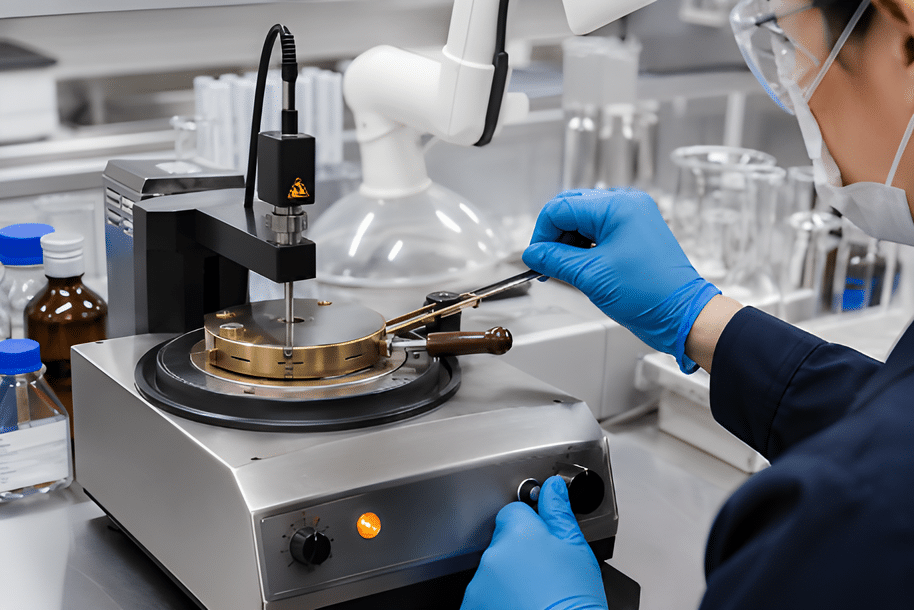
Flash point is one of the most familiar flammability properties, but it is frequently overinterpreted. It indicates the lowest temperature at which vapors ignite momentarily in the selected test configuration. It does not mean the liquid is harmless below that temperature, nor does it describe sustained burning, autoignition, explosion severity, or every possible process condition.
Open-cup and closed-cup methods can produce different results because vapor containment differs. The appropriate method depends on the material, expected range, specification, and regulatory or product objective. Mixtures deserve special attention: composition can shift through evaporation, distillation, contamination, or solvent recovery, changing the flash point over time.
3. Autoignition Temperature: controlling hot surfaces
AIT addresses ignition without a spark or flame. It helps evaluate exposure to heaters, ovens, exhausts, bearings, steam lines, hot motors, compressors, and other elevated-temperature surfaces. AIT is method-dependent and should not be treated as an absolute physical constant. Vessel size, residence time, pressure, concentration, and surface condition can affect the observation.
Engineering limits should include conservatism and account for temperature gradients, fouling, insulation damage, localized hot spots, control failure, and abnormal operation. When electrical equipment selection is involved, AIT data may inform—but does not replace—a complete hazardous area classification and equipment temperature-class review.
4. Explosion Severity: understanding consequence
Pmax represents the maximum pressure developed by a deflagration in the test vessel. Kg normalizes the maximum rate of pressure rise by vessel volume. Together they help characterize how rapidly and strongly a gas or vapor explosion can develop. These values are relevant when evaluating equipment strength, explosion isolation, venting, suppression, occupied-building exposure, and emergency response assumptions.
Severity testing must use a justified mixture concentration and initial conditions. A result at room temperature and atmospheric pressure may not bound a heated or pressurized process. Similarly, a pure solvent value may not represent a multicomponent vapor stream or fuel mixed with an inert gas.
5. Flammability Diagram: seeing the operating envelope
A ternary flammability diagram plots fuel, oxygen, and inert gas composition. The flammable region lies between fuel-rich, fuel-lean, and oxygen-deficient boundaries. This representation is valuable for inerting and purging because it shows how a vessel composition moves during air removal, fuel introduction, normal operation, shutdown, and air re-entry.
- Fuel-rich region: Above UFL — Too much fuel to propagate under the tested condition.
- Flammable envelope: Between LFL and UFL with sufficient oxygen — Ignition can propagate.
- Oxygen-deficient region: Below LOC — Inerting prevents propagation for the tested system.
- Fuel-lean region: Below LFL — Insufficient fuel to propagate.
- Engineering margin: Inside the nonflammable side of a boundary — Accounts for uncertainty and process variability.
Figure 3. Conceptual operating regions. Actual boundaries must come from data for the specific fuel–oxidant–inert system and conditions.
6. Minimum Ignition Energy: evaluating electrostatic vulnerability
MIE testing evaluates how little spark energy may be sufficient to initiate combustion. Low MIE values signal that routine electrostatic discharges may be credible ignition sources. The result informs controls such as conductive transfer paths, bonding and grounding, flow-rate restrictions, conductive hoses, appropriate containers, humidity strategy where applicable, and verification of resistance to ground.
MIE should be interpreted with the actual vapor concentration and operating environment in mind. Ignition sensitivity is often greatest near an optimum concentration rather than exactly at the LFL. A complete electrostatic risk assessment also considers charge-generation mechanisms, capacitance, personnel grounding, insulating components, and the type of discharge that can occur.
7. Flammability Limits: defining where combustion can propagate
The lower flammability limit is the minimum fuel concentration that supports flame propagation; the upper flammability limit is the maximum. Below the LFL, the mixture is too lean. Above the UFL, it is too rich—although dilution with air can move a rich mixture back through the flammable range. This is a critical consideration during vessel opening, ventilation, purging, and emergency response.
Limits can change significantly with temperature, pressure, oxygen concentration, diluent, and mixture composition. Testing at representative conditions can be essential when defining gas detector alarm levels, minimum ventilation, safe startup and shutdown sequences, or control-room operating envelopes.
8. Vapor Pressure and Burning Velocity: completing the picture
Vapor pressure indicates a liquid’s tendency to enter the vapor phase. It helps connect liquid temperature and composition to the concentration that may develop in a headspace or release. Combined with flash point and flammability-limit data, it supports estimates of whether a spill, open operation, tank headspace, or equipment leak can form an ignitable atmosphere.
Burning velocity characterizes flame-front propagation. For refrigerants, ISO 817 testing can support classification under ASHRAE Standard 34. It can also help compare formulations and understand flame behavior where propagation rate—not only the existence of a flammable range—is important.
Standard testing versus process-condition simulation
Standardized testing provides comparability, repeatability, and a recognized basis for regulatory or specification decisions. Process-condition testing addresses a different need: determining how the material behaves in the actual or worst credible operating envelope. The two approaches are complementary.
| Question | Standard-condition test | Representative-condition test |
|---|---|---|
| Primary purpose | Comparable property or classification value | Engineering evidence for a specific process scenario |
| Typical conditions | Defined by the test method | Selected temperature, pressure, oxygen, inert gas, and composition |
| Best use | SDS, screening, specification, regulatory support | Scale-up, safe operating limits, inerting, upset assessment, protection design |
| Key caution | May not represent adverse process conditions | Must be designed and documented so the result is technically defensible |
How to build an effective test program
- Define the decision. Clarify whether the result will support classification, ventilation, inerting, electrical area classification, equipment protection, relief design, product development, or a broader risk assessment.
- Describe the material and process. Provide composition, impurities, physical state, operating temperatures and pressures, oxygen and inert-gas levels, batch or continuous mode, credible deviations, and sampling history.
- Select the correct sample. Use a representative material. For changing mixtures, identify whether fresh, recycled, concentrated, weathered, contaminated, or end-of-batch samples could control the hazard.
- Choose methods and conditions. Align recognized methods with the intended regulatory or engineering use. Identify any justified modifications needed to simulate process conditions.
- Review the data as a system. Interpret ignition sensitivity, flammable range, oxygen dependence, vapor generation, and explosion consequence together. Note uncertainty and limitations.
- Translate results into controls. Establish operating limits, alarm and interlock setpoints, ventilation or inerting requirements, inspection and maintenance needs, emergency actions, and management-of-change triggers.
From test result to risk reduction
Laboratory data become most valuable when integrated into a Process Hazard Analysis or Fire and Explosion Hazard Analysis. The assessment should connect each property to credible release scenarios, ignition sources, safeguards, human factors, and consequence.
Where flammable gases or vapors may be present, a Hazardous Area Classification can use release frequency, ventilation, material properties, and process configuration to define classified locations and guide suitable electrical equipment. Testing may also support gas detector placement and alarm philosophy, hot-work controls, ventilation design, inerting, bonding and grounding, and written operating procedures.
When should testing be performed or repeated?
- During research and product development, especially when comparing formulations, solvents, refrigerants, or propellants.
- Before scale-up, commercialization, or introduction of a new material into existing equipment.
- When designing or modifying tanks, reactors, dryers, ovens, vapor recovery, ventilation, inerting, or explosion protection.
- When a process will operate at elevated temperature, elevated pressure, reduced oxygen, oxygen enrichment, or changing composition.
- After a formulation, supplier, impurity profile, operating range, cleaning solvent, or recycle stream changes.
- When existing data are missing, method details are unclear, or published values do not represent the process.
- Following an incident, near miss, unexpected ignition, or abnormal flammable-gas detection event.
- As part of management of change, PHA revalidation, hazardous area classification, or preparation/update of safety documentation.
Why use an independent third-party laboratory?
A qualified third-party laboratory provides controlled methods, calibrated equipment, traceable documentation, independent results, and specialists who can challenge assumptions about sample selection and process conditions. This strengthens the technical basis for internal decisions, customer requirements, regulatory submissions, insurance reviews, incident investigations, and capital projects.
Prime Process Safety Center combines laboratory testing with process safety consulting so results can be interpreted in the context of the facility. Explore the full testing capabilities or review related combustible dust testing when powders or particulate solids are also present.
Frequently Asked Questions
What is flammability testing?
Flammability testing is a group of laboratory methods used to determine whether a material can ignite or support flame propagation, the conditions under which ignition occurs, and the potential severity of combustion. Depending on the need, it may include flash point, flammability limits, AIT, LOC, MIE, Pmax/Kg, vapor pressure, or burning velocity.
Why is flammability testing important?
It replaces assumptions with measured data. The results help prevent fires and explosions, define safe operating limits, design ventilation and inerting, control ignition sources, select equipment, support hazard studies, and improve emergency planning.
What types of materials can be tested?
Common samples include gases, volatile liquids, solvents, solvent blends, fuels, refrigerants, aerosols or propellant components, process vapors, and multicomponent mixtures. Powders and dusts require dedicated combustible-dust methods because their hazards and test equipment differ.
When should testing be conducted?
Testing is appropriate when data are unavailable or unreliable, before scale-up or process design, when operating conditions differ from published data, during product reformulation or management of change, and after an incident or unexpected process behavior.
What information can flammability testing provide?
It can define the temperatures, concentrations, oxygen levels, and ignition energies associated with combustion; characterize vapor generation; quantify explosion pressure and rate of pressure rise; and provide inputs for control and protection strategies.
How does testing support product development?
Testing allows developers to compare formulations, substitute solvents or refrigerants, evaluate the effect of concentration and temperature, identify safer alternatives, anticipate labeling or transport implications, and design risk controls before commercialization.
What industries commonly use these services?
Chemical, pharmaceutical, energy, aerospace, automotive, electronics, refrigerant/HVAC, coatings, consumer products, waste treatment, and any industry using flammable gases or volatile liquids.
Can testing support regulatory compliance?
Yes. Properly selected methods can support hazard communication, safety documentation, transport or product classification, OSHA process safety activities, fire-code assessments, electrical area classification, and conformance with applicable ASTM, ISO, NFPA, IEC, ASHRAE, UN, or other requirements. The exact method must match the regulatory purpose.
Why use a third-party laboratory?
Independent testing improves credibility and traceability. A specialized laboratory can select suitable methods, control test conditions, document limitations, and provide interpretation that internal teams or generic published data may not offer.
Is one flammability test enough?
Often, no. Flash point answers a different question from AIT, LOC, MIE, or explosion severity. The right set depends on the material, process scenario, and engineering decision.
Can tests be performed at elevated temperature or pressure?
Where suitable equipment and methods are available, testing can be designed to examine representative or adverse conditions. The protocol should define the basis, limitations, safety controls, and how the result will be used.
How much sample is required?
Sample quantity depends on the test method, number of replicates, expected range, material volatility, and whether several conditions or compositions will be evaluated. Confirm the test matrix before shipping, and provide a current SDS and relevant handling information.
Plan testing around the decisions that matter
The most defensible flammability program begins with the process—not the test catalog. Define the credible conditions, choose representative samples, select methods that answer specific engineering questions, and apply appropriate margins when translating laboratory results into operating limits and safeguards.
