

Chemical Reaction Hazard Testing & Reactive Chemical Services
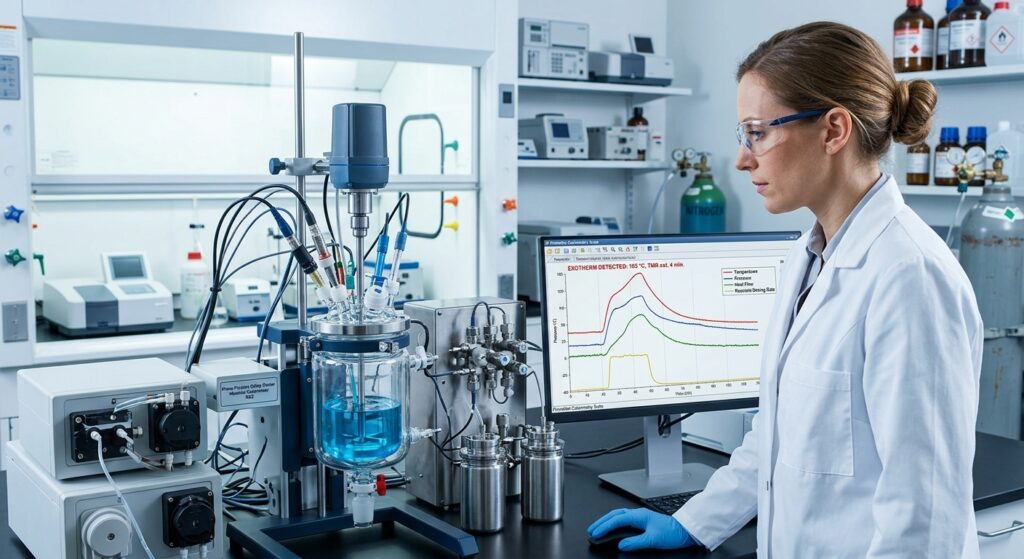
Get the critical data you need to design safer, smarter chemical processes.
Chemical reaction calorimetry supports the evaluation of heat release, pressure generation, accumulation, and scale-up risk.
Understanding how chemicals behave under process conditions is essential to preventing thermal runaway, pressure buildup, and catastrophic loss of containment.
Prime Process Safety Center combines laboratory testing, advanced calorimetric studies, and process-safety engineering to help organizations detect hazards early, establish defensible operating limits, and make informed scale-up decisions.
What Is Chemical Reaction Hazard Testing?
Chemical reaction hazard testing is a structured laboratory and engineering process used to evaluate the thermal and pressure-generating behavior of raw materials, intermediates, products, wastes, and process reaction mixtures. It examines both intended chemistry and credible abnormal conditions.
A complete evaluation is designed to answer questions such as:
- At what temperature does measurable self-heating, decomposition, or an unintended reaction begin?
- How much heat can the reaction generate, and how rapidly will that heat be released?
- Could a loss of cooling, agitation, or controlled dosing cause a self-accelerating runaway?
- Will boiling, foaming, vapor generation, or permanent-gas production create overpressure?
- Could unreacted material accumulate during a semi-batch process?
- Are raw materials, contaminants, cleaning agents, or utilities chemically incompatible?
- What safeguards, shutdown limits, and emergency-relief capacity are required?
A formal chemical reaction hazard assessment combines process review, laboratory evidence, and engineering interpretation so the testing program addresses the actual operating scenario.
Why Reaction Hazards Escalate
Exothermic reactions release heat. Under normal operation, that heat is removed by a jacket, coil, condenser, reflux system, or external exchanger. A hazardous condition develops when heat generation exceeds heat-removal capacity. The rising temperature accelerates reaction kinetics, producing still more heat and potentially creating a self-reinforcing escalation.
How an Upset Can Become Self-Accelerating
Figure 1. A typical thermal-runaway feedback cycle following loss of cooling, mixing, or another critical control.
Scale-up intensifies this concern. A small laboratory vessel can lose heat quickly because of its relatively high surface-area-to-volume ratio. A production reactor retains heat more effectively. Consequently, a reaction that appears controlled at bench scale may reach a much higher temperature or pressure in a full-scale vessel.
When Testing Should Be Performed
- Developing a new reaction, formulation, or synthesis route.
- Moving from laboratory to pilot or commercial production.
- Increasing batch size, throughput, concentration, or reagent feed rate.
- Changing a raw-material supplier, grade, purity, solvent, catalyst, initiator, or stabilizer.
- Modifying the operating temperature, pressure, addition sequence, or agitation system.
- Performing a Process Hazard Analysis (PHA), HAZOP, Management of Change (MOC), or pre-startup review.
- Designing or validating reactor cooling and emergency pressure-relief systems.
- Investigating an unexpected temperature rise, pressure excursion, discoloration, gas evolution, or product-quality deviation.
- Establishing storage, shipping, waste-handling, or emergency-response limits.
A Tiered Testing Strategy
Not every material requires every test. A cost-effective program begins with chemistry review and small-scale screening, then progresses to process-representative or adiabatic testing when the screening results indicate significant exothermicity, decomposition, gas generation, or incompatibility.
A Tiered Strategy: Test Only as Deeply as the Hazard Requires
Chemistry Review
Materials • Operating Envelope
Screening
DSC • TGA • DTA
Representative Testing
ARC • Reaction Calorimetry
Engineering Use
VSP II • DIERS • Safeguards
Figure 2. A tiered program moves from screening to representative testing and engineering application.
The chosen test must match the decision to be made. A small-scale DSC result may identify a decomposition hazard, but it is not a substitute for low-thermal-inertia calorimetry when emergency relief sizing or two-phase venting behavior must be evaluated.
Core Chemical Reaction Hazard Tests
1. Differential Scanning Calorimetry (DSC)
DSC is commonly used for initial thermal screening. A small sample is heated under a defined program while the instrument measures heat flow. Testing can identify apparent onset temperature, peak temperature, heat of reaction or decomposition, and multiple thermal events. Results depend on sample mass, heating rate, atmosphere, and containment; therefore, a DSC onset should not automatically be treated as a plant operating limit.
2. Thermogravimetric Analysis (TGA)
TGA measures sample mass as temperature or time changes. It can reveal moisture or solvent loss, volatilization, oxidation, decomposition ranges, residual solids, and multi-stage degradation. Interpreting TGA together with DSC helps distinguish evaporation from chemical decomposition.
3. Differential Thermal Analysis (DTA)
DTA compares a sample’s temperature response with an inert reference. It can identify thermal transitions, oxidation, crystallization, and decomposition, complementing other screening techniques.
4. Accelerating Rate Calorimetry (ARC)
ARC evaluates a sample under low-heat-loss or near-adiabatic conditions. Heat-wait-search testing can determine detected onset of self-heating, temperature and pressure rise rates, maximum temperature and pressure, and time-to-maximum-rate behavior. The data support safe operating limits, storage evaluations, kinetics, and runaway-severity analysis.
5. Reaction Calorimetry
Reaction calorimetry measures heat generation during the actual reaction under controlled, process-representative mixing, dosing, and temperature conditions. It can quantify total reaction heat, heat-release rate, cooling demand, adiabatic temperature rise, reactant accumulation, and the Maximum Temperature of the Synthesis Reaction (MTSR). This is especially important for semi-batch processes where feed can accumulate faster than it reacts. Explore our full range of calorimetric studies to optimize reactor safety.
6. Vent Sizing Package II (VSP II)
VSP II is a low-thermal-inertia adiabatic calorimeter used to characterize runaway temperature and pressure behavior. It supports evaluation of vapor, gassy, and hybrid systems; boiling, foaming, and two-phase discharge; reaction behavior at relief conditions; and the effectiveness of quench or inhibition strategies. The resulting data may be used in DIERS-based emergency relief evaluations.
Key Parameters and Their Meaning
| Parameter | Process-Safety Significance |
|---|---|
| Apparent onset temperature | Temperature at which the selected instrument and method detect measurable reaction or decomposition. |
| Heat of reaction | Total energy released or absorbed; used to estimate the potential adiabatic temperature rise. |
| Heat-release rate | Rate of thermal energy generation; critical when comparing the reaction load with available cooling. |
| Adiabatic temperature rise | Potential temperature increase if the reaction proceeds without heat removal. |
| Self-heating rate | Rate of temperature rise caused by the reaction under the test conditions. |
| Pressure-generation rate | Rate of pressure increase from boiling, decomposition, vapor formation, or permanent-gas generation. |
| MTSR | Maximum Temperature of the Synthesis Reaction after a defined upset, commonly loss of cooling. |
| TMR | Estimated time to maximum self-heating rate at a stated starting temperature and defined model assumptions. |
| Phi factor | Thermal-inertia ratio of sample plus test cell to sample; lower values generally provide more process-representative adiabatic data. |
| Gas generation | Quantity and rate of noncondensable gas produced, which can control overpressure and relief requirements. |
Test Normal and Credible Abnormal Scenarios
Testing only the intended reaction can overlook the scenario most likely to cause an incident. The program should consider reasonably foreseeable deviations identified through process review or hazard analysis:
- Loss of cooling, agitation, reflux, or condenser service.
- Rapid addition, double charge, delayed initiation, or incorrect order of addition.
- Excess catalyst, initiator, or reactant concentration.
- Wrong material, water ingress, air exposure, or contamination by acid, base, metal, rust, or cleaning agent.
- Solvent loss, concentration increase, prolonged hold time, or elevated storage temperature.
- Blocked vent, external fire exposure, or failed temperature-control instrumentation.
Where inadvertent mixtures are credible, chemical compatibility studies can determine whether contact generates heat, gas, pressure, polymerization, decomposition, or toxic products. For related vapor-phase safety concerns, read our gas and vapor flammability testing overview.
Turning Laboratory Data into Safer Design
The purpose of testing is not merely to produce an instrument curve. Laboratory findings should be translated into specific engineering and operational decisions, including:
- Normal operating, alarm, interlock, and emergency-shutdown temperature limits.
- Maximum reagent addition rate, batch size, concentration, and allowable accumulation.
- Required heat-transfer area, utility reliability, and emergency cooling capacity.
- Agitation monitoring, feed interlocks, and automated shutdown logic.
- Quench, dilution, or reaction-inhibition strategies.
- Storage-temperature limits and maximum safe hold time.
- Emergency relief load, relief-device sizing, and two-phase-flow assumptions.
- Safe routing and treatment of relieved vapor, liquid, foam, or toxic effluent.
Where significant pressure generation is possible, results can support emergency relief-system design and DIERS technology for two-phase relief. Complex systems may also benefit from process dynamic simulation to evaluate the interaction among kinetics, heat transfer, controls, pressure, and relief performance.
Supporting PHA, PSM, RMP, and Management of Change
Measured reaction data strengthen process-safety programs by replacing qualitative assumptions with defensible information. Results may support process safety information, HAZOP and What-If reviews, Layer of Protection Analysis (LOPA), safe operating limits, operating procedures, Management of Change (MOC), pre-startup reviews, emergency planning, incident investigations, and relief-system documentation.
If your facility handles workplace hazard documentation or transportation compliance, see our guides on testing needed for SDS creation and UN/DOT testing & classification.
OSHA states that its Process Safety Management standard is intended to prevent or minimize catastrophic releases involving toxic, reactive, flammable, or explosive chemicals. EPA’s Risk Management Program likewise addresses chemical-accident prevention at covered facilities. Testing does not by itself establish compliance, but it supplies the technical data required to make and document sound decisions.
Information Needed Before Testing
- Chemical identities, compositions, concentrations, and safety data sheets.
- Reaction equation, expected intermediates, products, and by-products.
- Batch size, reactor volume, normal temperature, and pressure.
- Charge quantities, sequence, feed rates, agitation, and expected reaction time.
- Cooling-system arrangement and available duty.
- Process flow diagrams, relevant P&IDs, and operating procedures.
- Known impurities, catalysts, inhibitors, and credible contamination scenarios.
- Previous laboratory, pilot, or incident data.
- Existing relief-device and discharge-system information.
- The business or engineering decision the testing must support.
Industries That Benefit
- Pharmaceuticals and active ingredients
- Specialty and fine chemicals
- Polymers, resins, adhesives, paints, and coatings
- Agrochemicals and fertilizers
- Petrochemicals, refining, and solvent recovery
- Batteries and energy-storage materials
- Cosmetics, personal care, food, and flavors
- Waste treatment, pilot plants, and contract manufacturing
Why Work with Prime Process Safety Center?
Prime Process Safety Center combines advanced laboratory capability with practical process-safety engineering. Our work goes beyond reporting an onset temperature: we help clients understand what the data mean for the actual process, equipment, and credible upset scenario. Discover how our integrated testing capabilities can help manage chemical plant risk.
Turn Reaction Uncertainty Into Actionable Safety Data
Before scaling up, modifying, or operating a reactive process, obtain the data needed to understand heat release, stability, and pressure generation. Prime Process Safety Center can develop a test program matched to your chemistry and engineering objective.
Contact Prime Process Safety Center to discuss samples, testing objectives, and project schedule.
Technical References
Related Blogs

Chemical Reaction Hazard Testing & Reactive Chemical Services
Understand the conditions that lead to gas and vapor explosions, common industrial scenarios, and how facilities can reduce the risk.
ASTM Testing Services
Understand the conditions that lead to gas and vapor explosions, common industrial scenarios, and how facilities can reduce the risk.
Aerosol Testing Services: Flammability, UN/DOT Classification and Safe Handling
Understand the conditions that lead to gas and vapor explosions, common industrial scenarios, and how facilities can reduce the risk.
DHA vs. PHA: How Should You Choose for Your Facility?
Understand the conditions that lead to gas and vapor explosions, common industrial scenarios, and how facilities can reduce the risk.

The 0.1% Mistake: How Trace Impurities Trigger Mass Thermal Runaway
Understand the conditions that lead to gas and vapor explosions, common industrial scenarios, and how facilities can reduce the risk.

Understanding the Hidden Dangers of Static Electricity in Plastic Containers and Liners
Understand the conditions that lead to gas and vapor explosions, common industrial scenarios, and how facilities can reduce the risk.
Invisible, Silent, and Costly: The Real Risk of Skipping Static Control
Understand the conditions that lead to gas and vapor explosions, common industrial scenarios, and how facilities can reduce the risk.

Invisible, Silent, and Costly: The Real Risk of Skipping Static Control
Understand the conditions that lead to gas and vapor explosions, common industrial scenarios, and how facilities can reduce the risk.

The Invisible Shield: Why Chemical Reaction Hazard Assessment is Your Ultimate Competitive Advantage
Understand the conditions that lead to gas and vapor explosions, common industrial scenarios, and how facilities can reduce the risk.

Common Gas and Vapor Explosion Scenarios in Industry
Understand the conditions that lead to gas and vapor explosions, common industrial scenarios, and how facilities can reduce the risk.
Flammable vs Combustible Liquids: What Sets Them Apart
Learn how flash point separates flammable and combustible liquids and what it means for safe storage and handling.

How Static Electricity Can Cause Fires in Your Facility
Learn how electrostatic charge buildup can create sparks that ignite flammable vapors, gases, and combustible dust in industrial operations.