

Why Aerosol Testing Matters

Aerosol products are convenient, efficient delivery systems—but the same pressurized package that makes them useful can also create distinct fire, explosion, container-rupture, transport, and hazard-communication concerns. The risk is not limited to fine sprays. Products that dispense foam, mousse, gel, paste, powder, liquid, or gas can contain flammable propellants or solvents and may form an ignitable mixture when released.
Testing converts those concerns into defensible data. It helps manufacturers determine the appropriate transport description and hazard division, classify workplace hazards, develop Safety Data Sheets (SDSs) and labels, establish packaging and storage safeguards, and answer questions from carriers, retailers, insurers, authorities having jurisdiction, and downstream users.
Prime Process Safety Center provides integrated testing capabilities for flammability, reactivity, and hazardous-material classification. Our laboratory data can be paired with practical guidance on product handling, storage, process design, and risk reduction.
Aerosols Are Class 2 Articles—but Classification Requires Care
For U.S. hazardous-material transportation, an aerosol is generally a non-refillable receptacle containing a gas compressed, liquefied, or dissolved under pressure and fitted with a self-closing release device. Aerosols are typically shipped under UN1950 and assigned within Class 2. The applicable U.S. transport divisions are:
- Division 2.1 — flammable gas hazard, including aerosols that meet the applicable flammability criteria.
- Division 2.2 — non-flammable, non-poisonous gas hazard for aerosols meeting the applicable criteria.
- Division 2.3 — toxic gas. Important distinction: 49 CFR does not permit Division 2.3 gases to be transported in an aerosol container; toxic or corrosive contents may instead create subsidiary hazards or may be prohibited, depending on their classification.
This distinction matters because “aerosol” is not simply another name for a compressed-gas cylinder, and workplace GHS aerosol categories are not interchangeable with DOT divisions. Current OSHA Hazard Communication criteria classify aerosols in Categories 1, 2, or 3 based on their flammable components, chemical heat of combustion, and—where applicable—spray or foam test results. The transport decision and the workplace-labeling decision should therefore be documented separately, even when they use some of the same test data.
Learn more about the broader transport framework through Prime Process Safety Center’s UN/DOT Testing & Classification services.
The Aerosol Flammability Classification Path
A technically sound program starts by reviewing the complete formulation, including the base product, propellant, flammable-component percentage, package size, valve, actuator, and discharge form. The chemical heat of combustion provides an initial measure of available energy. Depending on the formulation and product format, the classification path then uses performance testing: ignition-distance and enclosed-space testing for spray aerosols, or foam-flammability testing for products released as foam, mousse, gel, or paste.
The finished aerosol dispenser—not only the bulk liquid—must be considered. Valve geometry, spray rate, droplet size, propellant ratio, discharge pattern, and the amount released can materially affect the observed fire behavior.
Core Aerosol Tests and What They Tell You
| Test | Primary Question | Typical Use of Result |
|---|---|---|
| Chemical heat of combustion | How much energy can the formulation release when completely burned? | Initial screening and input to aerosol flammability classification. |
| Ignition-distance test | Can a spray ignite at specified distances from an ignition source? | Classifies spray-aerosol flame propagation and ignition reach. |
| Enclosed-space ignition test | Can the discharged aerosol create an ignitable atmosphere in a confined volume? | Evaluates spray aerosols whose open-air result does not fully resolve classification. |
| Foam-flammability test | How long and how high does flame persist in a dispensed foam, mousse, gel, or paste? | Classifies non-spray aerosol discharge forms. |
| Flame-projection test | Does a flame project back or extend from an aerosol placed near an open flame? | Supports product screening, certain regulatory programs, and risk characterization. |
1. Chemical Heat of Combustion
Chemical heat of combustion is the energy released per unit mass when the formulation burns completely. It is commonly reported in kilojoules per gram (kJ/g) and is a key input to aerosol classification. A bomb-calorimetry method such as ASTM D240 may be used for suitable liquid hydrocarbon fuels and formulation components, while the applicable regulation or UN procedure governs how the aerosol’s chemical heat of combustion is established for classification. The test plan must therefore match the product matrix and the governing decision—not merely select a familiar ASTM method by name.
Heat-release data can also complement broader calorimetric studies and reactive-chemical evaluations when a product has unusual thermal or reactive behavior.
2. Ignition-Distance Test for Spray Aerosols
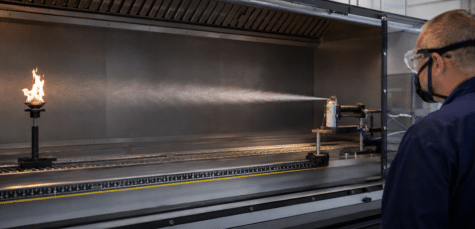
The ignition-distance test evaluates whether a spray emitted from an aerosol dispenser ignites and sustains flame at defined distances from an ignition source. The dispenser is conditioned, positioned, and discharged in a controlled apparatus while the ignition source is placed at specified intervals. The laboratory records ignition, flame propagation, and the maximum distance at which ignition occurs under the prescribed conditions.
The result helps distinguish a short-lived local flame from a spray plume that can transmit fire over a meaningful distance. That information is directly relevant to foreseeable use near pilot lights, burners, hot work, energized equipment, and other ignition sources.
3. Enclosed-Space Ignition Test
Some aerosol sprays may not show a long ignition distance in open air yet can still accumulate to an ignitable concentration in a small room, cabinet, vehicle interior, or other confined volume. The enclosed-space ignition test—sometimes informally called the closed-drum test—evaluates this scenario by discharging a measured quantity into a defined enclosure and observing ignition behavior under standardized conditions.
The test provides data such as the amount discharged before ignition and the deflagration density. These results help determine classification and provide practical insight into ventilation, instructions for use, ignition-source control, and storage or display arrangements. The internationally recognized classification procedures are found in Section 31 of the UN Manual of Tests and Criteria. ASTM D3065 addresses flammability of aerosol products and is often referenced for flame-projection or related aerosol flammability evaluation; the governing protocol should be confirmed before testing.
4. Aerosol Foam Flammability Test
A foam, mousse, gel, or paste does not behave like an airborne spray plume. The product can remain as a concentrated mass, continue releasing flammable vapor, and burn for a measurable duration. The foam-flammability test dispenses a prescribed amount of product, applies an ignition source under controlled conditions, and records parameters such as flame height and flame duration.
This test is the appropriate branch of the classification scheme for non-spray aerosol products. Examples can include personal-care mousse, shaving foam, styling products, adhesive or sealant foams, food-related foams, cleaning gels, and industrial pastes—subject to the precise regulatory definition and product configuration.
5. Flame-Projection Testing
Flame-projection testing evaluates whether an aerosol discharged near an open flame produces flame extension, flashback, or a sustained projection. It can be valuable for screening product configurations and may be required by a particular jurisdiction, specification, customer program, or legacy classification system. Because “flame projection,” “ignition distance,” and “enclosed-space ignition” are not interchangeable tests, the laboratory should confirm the governing standard, acceptance criteria, and intended market before issuing a quotation or classification statement.
Beyond Flammability: Other Hazards to Evaluate
Aerosol flammability classification is only one part of product safety. A complete assessment may also need to address:
- Container pressure, leakage, deformation, bursting, thermal exposure, and packaging compatibility.
- Acute toxicity, irritation, sensitization, aspiration hazard, corrosivity, or environmental hazards associated with the ingredients or combustion products.
- Reactive, oxidizing, self-heating, water-reactive, or chemically unstable components.
- Electrostatic ignition, ventilation, and hazardous-location considerations during filling, blending, propellant charging, leak testing, warehousing, and waste handling.
- Changes in formulation, propellant source, valve or actuator, fill weight, package geometry, or manufacturing process that could invalidate prior data.
For formulations that may create additional vapor hazards, review Prime Process Safety Center’s gas and vapor flammability testing overview. For products requiring workplace documentation, see testing needed for SDS creation.
How Test Results Support Compliance and Business Decisions
Reliable aerosol data can support several overlapping—but distinct—obligations and decisions:
- DOT/UN transport classification: proper shipping name, identification number, hazard division, subsidiary hazards, marks, labels, packaging, quantity limits, documentation, and mode-specific restrictions.
- OSHA Hazard Communication: physical-hazard category, signal word, pictograms, hazard statements, precautionary statements, and SDS content.
- NFPA 30B and fire-code compliance: storage level, warehouse protection, retail display, manufacturing safeguards, and coordination with the authority having jurisdiction. Project-specific code review is essential because quantity, product mix, packaging, building configuration, and protection features all matter.
- Product development and quality control: comparison of formulations, propellants, valves, discharge rates, or packaging alternatives before commercialization.
- Risk management: credible fire scenarios, ventilation and ignition-source controls, emergency planning, insurer questions, and safer operating procedures.
Testing does not replace regulatory interpretation. The most defensible approach links each result to the exact product configuration, test method, edition, conditioning parameters, observations, uncertainty or limitations, and the classification rule being applied.
What to Provide When Requesting an Aerosol Test
- Product identity and intended use, including whether the discharge is a spray, foam, mousse, gel, paste, powder, liquid, or gas.
- Complete formulation or compositional ranges, including propellant type and percentage of ingredients classified as flammable.
- A current SDS for each ingredient and the finished product, if available.
- Aerosol container size, fill weight, internal pressure information, valve and actuator details, spray rate, and discharge pattern.
- Target markets and governing needs—for example U.S. DOT ground transport, air or vessel shipment, OSHA labeling, international GHS, fire-code review, retailer specification, or product-development screening.
- Representative finished packages from normal production, plus any variants that differ in formulation, propellant, package, valve, or actuator.
- Known toxic, irritant, corrosive, reactive, or unusual combustion-product concerns so the laboratory can plan safe containment and exhaust controls.
A Practical Testing and Classification Workflow
- Define the decision. Identify every jurisdiction, transport mode, workplace rule, code, or customer specification the data must support.
- Review the formulation and package. Determine whether existing validated data are applicable and identify information gaps.
- Select the correct test branch. Use heat-of-combustion data and the product’s discharge form to select spray or foam testing, along with any supplemental evaluations.
- Test representative finished products. Control conditioning, discharge rate, apparatus geometry, ignition source, ventilation, and observation criteria.
- Interpret the results against the governing criteria. Keep DOT divisions, OSHA aerosol categories, and fire-code storage classifications distinct.
- Issue a traceable report. Document samples, methods, results, deviations, photographs, and classification rationale.
- Apply the data. Update SDSs, labels, shipping descriptions, packaging, storage plans, operating procedures, and change-control records.
Why Work with Prime Process Safety Center?
Prime Process Safety Center combines laboratory testing with process-safety consulting. Our ISO/IEC 17025:2017 accredited laboratorysupports reliable, technically defensible evaluation, while our consultants help translate results into practical safeguards for manufacturing, storage, transportation, and use.
- Application-focused test planning based on the product, package, market, and regulatory decision.
- Clear reports that connect observations and measured data to classification criteria.
- Support for flammable, irritant, toxic, corrosive, or reactive formulations that require additional planning and containment.
- Integrated services for UN/DOT classification, gas and vapor flammability, reactive-chemical testing, SDS data development, electrostatics, fire and explosion risk, and facility safety reviews.
Frequently Asked Questions
Are all aerosols classified as flammable?
No. Aerosols may be assigned as flammable or non-flammable for transport and may fall into OSHA aerosol Categories 1, 2, or 3. The formulation, flammable-component content, heat of combustion, and applicable performance tests determine the result.
Can I classify an aerosol using only the propellant SDS?
Usually not. Classification must consider the finished aerosol, including the base formulation, propellant concentration, package, valve, actuator, and discharge form. A flammable propellant does not by itself provide all required finished-product data.
Which test is used for foam, mousse, gel, or paste aerosols?
The aerosol foam-flammability test is the relevant performance test branch. Ignition-distance and enclosed-space tests are designed for spray aerosols.
Is ASTM D3065 the same as the UN enclosed-space test?
No. ASTM D3065 is associated with aerosol flammability evaluation, including flame-projection testing, while the UN Manual Section 31 contains the classification procedures for ignition-distance, enclosed-space, and foam-flammability tests. The exact protocol must match the regulatory purpose.
Does an aerosol need to be retested after a product change?
Potentially. Changes to formulation, propellant, fill ratio, valve, actuator, spray rate, package size, or manufacturing process can affect flammability. Change control should determine whether prior data remain representative.
Can one report support transport, SDS, and fire-code needs?
A coordinated test program can generate data useful for all three, but the final classifications are governed by different criteria. Each conclusion should be stated separately and tied to the applicable rule or code.
Technical References
- 49 CFR § 171.8 — Definitions and abbreviations
- 49 CFR § 173.115 — Class 2 definitions and aerosol classification provisions
- OSHA 29 CFR 1910.1200, Appendix B — Physical Hazard Criteria
- OSHA 29 CFR 1910.1200, Appendix C — Allocation of Label Elements
- UN Manual of Tests and Criteria, Part III, Section 31 — Aerosol flammability classification procedures
- NFPA 30B — Code for the Manufacture and Storage of Aerosol Products
Related Blogs

Basket Self-Heating and Scale-Up Testing
Understand the conditions that lead to gas and vapor explosions, common industrial scenarios, and how facilities can reduce the risk.

How to Prevent Dust Explosions and Meet NFPA 660 Requirements
Understand the conditions that lead to gas and vapor explosions, common industrial scenarios, and how facilities can reduce the risk.

Flammability Testing Services
Understand the conditions that lead to gas and vapor explosions, common industrial scenarios, and how facilities can reduce the risk.

Building a Combustible Dust Safety Program
Understand the conditions that lead to gas and vapor explosions, common industrial scenarios, and how facilities can reduce the risk.

ATEX vs IECEx Hazardous Area Classification
Understand the conditions that lead to gas and vapor explosions, common industrial scenarios, and how facilities can reduce the risk.
Protect Against Electrostatic Hazards
Understand the conditions that lead to gas and vapor explosions, common industrial scenarios, and how facilities can reduce the risk.
Soil Resistivity Information and Field Testing
Understand the conditions that lead to gas and vapor explosions, common industrial scenarios, and how facilities can reduce the risk.

SDS Creation and Physical Property Testing
Understand the conditions that lead to gas and vapor explosions, common industrial scenarios, and how facilities can reduce the risk.

UN/DOT HAZARDOUS MATERIALS TESTING
Understand the conditions that lead to gas and vapor explosions, common industrial scenarios, and how facilities can reduce the risk.

Thermal Stability Testing
Understand the conditions that lead to gas and vapor explosions, common industrial scenarios, and how facilities can reduce the risk.

Combustible Dust Hazard Identification and the Dust Hazard Analysis (DHA)
Understand the conditions that lead to gas and vapor explosions, common industrial scenarios, and how facilities can reduce the risk.

Chemical Reaction Hazard Testing & Reactive Chemical Services
Understand the conditions that lead to gas and vapor explosions, common industrial scenarios, and how facilities can reduce the risk.