


Basket Self-Heating and Scale-Up Testing
A powder that appears stable in a small sample may behave differently in a drum, FIBC, hopper, or silo. As an accumulation grows, internally generated heat can become harder to dissipate. If heat generation exceeds heat loss, the material may smolder, ignite, or create an ignition source for a secondary dust explosion.
Prime Process Safety Center combines basket self-heating testing with facility-specific interpretation to help establish a defensible basis for bulk storage temperatures and configurations.
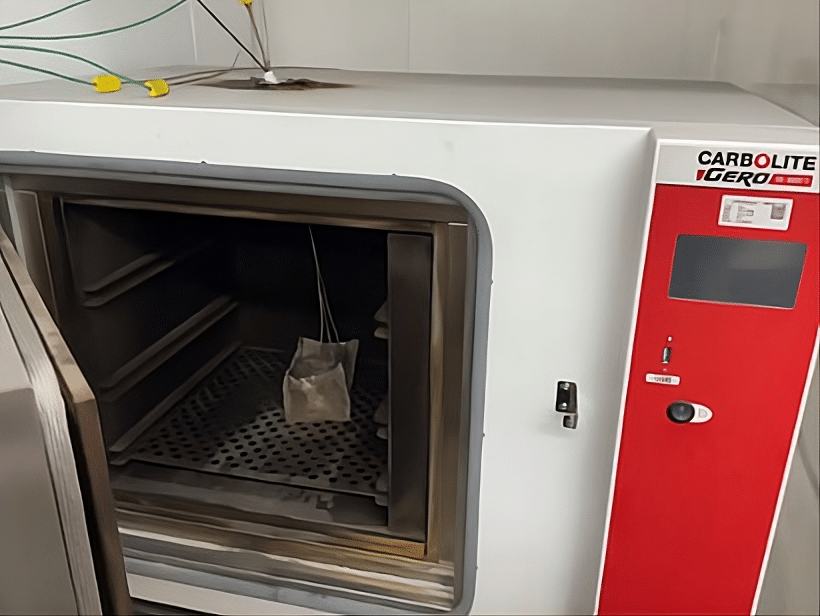
What Is EN 15188 Basket Self-Heating Testing
EN 15188 describes hot-storage experiments for determining the spontaneous ignition behavior of dust and granular-material accumulations. Representative material is held in a wire-mesh basket in a constant-temperature oven while the center of the sample and surrounding oven temperatures are monitored. Testing several basket volumes establishes how self-ignition temperature (TSI) depends on accumulation size.
For each size, oven temperatures are selected to bracket stable behavior and accelerating self-heating. The resulting temperature-time records also help describe induction behavior. The exact basket sizes, observation periods, and bracketing increments are specified for the material and project.
Prime Process Safety Center basket self-heating service
Why Storage Size and Geometry Matter
Self-heating is a competition between internal heat generation and heat loss at the accumulation boundary. Small packages generally expose more surface area relative to their volume. Larger or deeper accumulations can retain heat for longer, lowering the critical temperature at which self-ignition becomes possible.
| Storage arrangement | Key evaluation question |
|---|---|
| Bag or small sack | Is the packaged material stable at its expected temperature? |
| Fiber drum | Does the increased depth change the thermal behavior? |
| FIBC or hopper | Has the product cooled enough for the expected hold time? |
| Silo or large bin | How do dimensions, geometry, heat transfer, and duration affect the ignition boundary? |
A temperature acceptable in a small bag cannot automatically be applied to a full-scale silo. Storage mass alone is insufficient: volume, exposed area, characteristic dimensions, bulk density, and boundary conditions all matter.
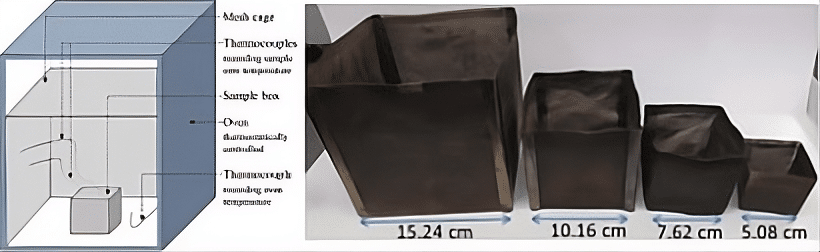
Illustration of a basket self-heating test setup.
From Laboratory Results to a Plant-Scale Assessment
A useful program starts with the plant decision: for example, whether warm dryer discharge can enter an FIBC, whether a hopper can retain product over a weekend, or what conditions need to be considered for a proposed silo. Prime Process Safety Center reviews the material, operating and upset temperatures, storage dimensions, residence time, and representative bulk density before defining a test plan.
Multiple basket results may be assessed using thermal explosion theory and, where applicable, the EN 15188 relationship between log(V/A) and reciprocal TSI. V/A reflects accumulation volume relative to exposed surface area. The Frank-Kamenetskii approach describes the balance between heat generation and heat removal with geometry-specific characteristic dimensions; finite boundary heat-transfer effects may also require consideration.
The applicability of a scaling relationship must be checked against the measured data. Extrapolation to a much larger vessel adds uncertainty. An extrapolated TSI is not automatically a maximum safe operating temperature; a plant limit also needs an engineering margin, storage duration, boundary conditions, and credible abnormal operation.
What the Testing Can Help Answer
- Can warm powder be discharged directly from a dryer into an FIBC or hopper?
- How does a change from a fiber drum to a supersack affect the assessment?
- Could a long shutdown or delayed discharge create a hazardous hold time?
- Would product cooling, reduced fill depth, or a different storage arrangement improve heat dissipation?
- Is additional testing required before establishing a full-scale silo operating basis?
Choosing the Right Self-Heating Test
A basket test represents hot storage of an accumulation. Other process conditions may require different tests. Prime Process Safety Center also offers bulk powder, aerated powder, and air-over-layer testing.
| Test | Represented condition | Primary use |
|---|---|---|
| Basket self-heating | Hot storage at defined accumulation sizes | TSI-versus-size relationship and scale-up |
| Bulk powder | Small bulk sample under heating | Initial bulk thermal-instability evaluation |
| Aerated powder | Heated air flowing through material | Through-flow or fluid-bed conditions |
| Air over powder layer | Heated air over a deposited layer | Dryer deposits and powder layers |
A fluid-bed dryer has strong airflow conditions that a hot-storage basket does not reproduce. Test selection should follow the physical condition of the process.
Representative Samples and Useful Project Inputs
Self-heating behavior may change with particle size, moisture, formulation, additives, bulk density, drying history, or contamination. The submitted sample should reflect the product actually stored, including credible variations. Useful project information includes discharge and storage temperatures, packaging dimensions, fill levels, hold times, and upstream heating conditions.
What Prime Process Safety Center Can Provide
A scoped project can provide basket temperature-time records, size-specific self-ignition findings, an assessment of the applicability of scale-up, and engineering conclusions for the proposed storage configuration. Recommendations may address product cooling, storage geometry, accumulation limits, operating temperature, monitoring, or further testing. Results can also be incorporated into a Dust Hazard Analysis where self-heating could supply an ignition source.
- Self-heating and thermal instability testing
- Self-heating evaluation and analysis
- Dust Hazard Analysis
Frequently Asked Questions
What does TSI mean?
TSI is the self-ignition temperature associated with a specified accumulation size under defined test conditions; it is not a universal safe temperature for every vessel.
Why test several basket sizes?
Multiple volumes establish how the ignition boundary changes with scale. One basket result cannot provide a reliable size-dependent relationship.
Can the results be used to assess a silo?
Yes, when the measured behavior supports the selected scaling method and the extrapolation is justified. Geometry, bulk density, heat transfer, hold time, and uncertainty must be considered.
Is a negative result in a small basket proof that bulk storage is safe?
No. A larger accumulation may retain heat more effectively and self-initiate at a lower surrounding temperature.
Is EN 15188 suitable for a fluid-bed dryer?
A basket represents hot storage, not strongly aerated powder. An aerated powder test is more directly relevant to through-flow conditions.
Is extrapolated TSI the allowable operating temperature?
No. An operating limit requires an engineering margin and assessment of normal and abnormal conditions.
Discuss Your Storage Configuration
Prime Process Safety Center can help connect laboratory self-heating data to decisions about drums, FIBCs, hoppers, silos, and other powder accumulations. Share the material, expected temperature, package or vessel dimensions, and storage duration to define a useful testing scope.

Related Blogs

Basket Self-Heating and Scale-Up Testing
Understand the conditions that lead to gas and vapor explosions, common industrial scenarios, and how facilities can reduce the risk.

How to Prevent Dust Explosions and Meet NFPA 660 Requirements
Understand the conditions that lead to gas and vapor explosions, common industrial scenarios, and how facilities can reduce the risk.
Flammability Testing Services
Understand the conditions that lead to gas and vapor explosions, common industrial scenarios, and how facilities can reduce the risk.

Building a Combustible Dust Safety Program
Understand the conditions that lead to gas and vapor explosions, common industrial scenarios, and how facilities can reduce the risk.

ATEX vs IECEx Hazardous Area Classification
Understand the conditions that lead to gas and vapor explosions, common industrial scenarios, and how facilities can reduce the risk.
Protect Against Electrostatic Hazards
Understand the conditions that lead to gas and vapor explosions, common industrial scenarios, and how facilities can reduce the risk.
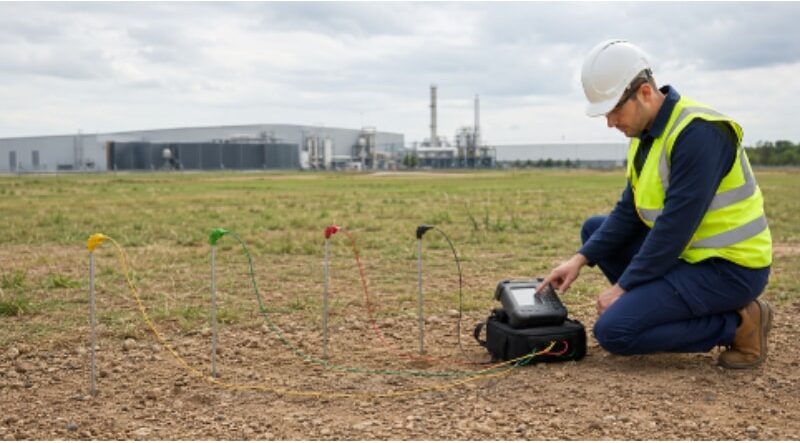
Soil Resistivity Information and Field Testing
Understand the conditions that lead to gas and vapor explosions, common industrial scenarios, and how facilities can reduce the risk.

SDS Creation and Physical Property Testing
Understand the conditions that lead to gas and vapor explosions, common industrial scenarios, and how facilities can reduce the risk.

UN/DOT HAZARDOUS MATERIALS TESTING
Understand the conditions that lead to gas and vapor explosions, common industrial scenarios, and how facilities can reduce the risk.

Thermal Stability Testing
Understand the conditions that lead to gas and vapor explosions, common industrial scenarios, and how facilities can reduce the risk.

Combustible Dust Hazard Identification and the Dust Hazard Analysis (DHA)
Understand the conditions that lead to gas and vapor explosions, common industrial scenarios, and how facilities can reduce the risk.

Chemical Reaction Hazard Testing & Reactive Chemical Services
Understand the conditions that lead to gas and vapor explosions, common industrial scenarios, and how facilities can reduce the risk.