


Table of Contents
- What is the Difference Between ATEX and IECEx
- Gas and Vapor Zones 0, 1 and 2
- What Determines the Extent of a Classified Area
- Combustible Dust Zones 20, 21 and 22
- How PPSC Performs a Hazardous Area Classification
- Gas Groups, Dust Groups and Temperature Limits
- Classification Does Not Eliminate Other Ignition Sources
- When Should a Classification Be Reviewed
- What Should the HAC Report Contain
- Frequently Asked Questions
- Request a PPSC Hazardous Area Classification
ATEX vs IECEx Hazardous Area Classification
How Prime Process Safety Center determines Zones and equipment requirements
Executive Summary
A hazardous area classification should answer more than “What Zone is this?” It should identify where an explosive atmosphere can occur, what can release flammable material, how often a release is expected, how far the area extends, and what equipment requirements follow.
Prime Process Safety Center (PPSC) develops hazardous area classifications for facilities handling flammable gases, vapors, liquids, and combustible dusts. A documented study gives process, electrical, and operations teams a common basis for equipment selection and ignition control.
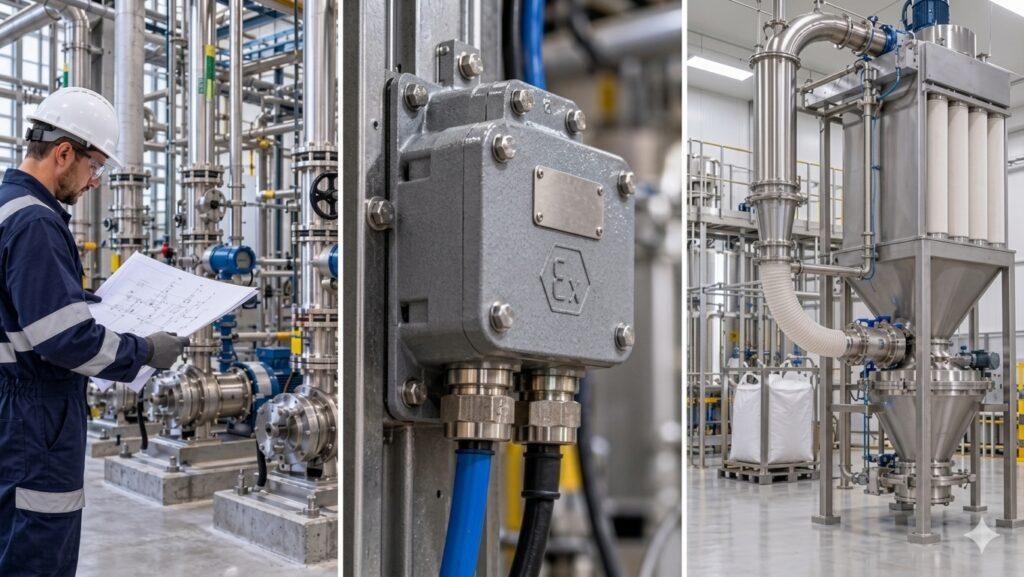
Illustrative industrial scenes: process walkdown, Ex enclosure, and enclosed powder handling. The image is not a classification drawing or evidence of equipment certification.
What is the Difference Between ATEX and IECEx
ATEX and IECEx use related explosive atmosphere concepts but serve different purposes. ATEX is part of the European Union legal framework. Directive 1999/92/EC addresses worker protection where explosive atmospheres may occur; Directive 2014/34/EU addresses equipment and protective systems intended for those atmospheres. IECEx is an international conformity assessment system based on IEC standards. The applicable national law and adopted code still govern each project.
Comparison of ATEX and IECEx Frameworks
| Topic | ATEX | IEC and IECEx |
|---|---|---|
| Main role | EU workplace and equipment requirements | International technical standards and conformity assessment |
| Gas and dust areas | Zones 0, 1, 2 and 20, 21, 22 | Zones 0, 1, 2 and 20, 21, 22 |
| Equipment decision | Appropriate ATEX category and marking | Appropriate EPL, certification and marking |
Table 1. Core differences between ATEX and IECEx conformity frameworks.
PPSC establishes the jurisdiction and design basis before assigning Zones. See our ATEX, EN and IEC standards resource.

Gas and Vapor Zones 0, 1 and 2
Gas zoning describes the frequency and duration of an explosive atmosphere. It does not prescribe a fixed distance from a pump, vent, or tank.
Gas Zone Definitions
| Zone | General Meaning | Typical EPL |
|---|---|---|
| 0 | Present continuously, for long periods, or frequently | Ga |
| 1 | Likely occasionally during normal operation | Gb |
| 2 | Unlikely during normal operation; if present, brief | Gc |
Table 2. Gas and vapor zone classifications and equipment protection levels.
A vessel vapor space, normal vent, and pump seal have different release characteristics. PPSC evaluates each source against actual pressure, temperature, fluid properties, operating practice, ventilation, and geometry. A radius copied from another facility does not establish a defensible boundary.
What Determines the Extent of a Classified Area
The boundary depends on release rate and duration and on dispersion. Relevant factors include opening size, process pressure, vapor pressure, relative vapor density, ventilation effectiveness and availability, room layout, pits, trenches, and obstructions. Nominal air changes per hour alone do not prove adequate dilution at the release point.

Combustible Dust Zones 20, 21 and 22
Dust classification requires separate consideration of airborne clouds and deposited layers. IEC 60079-10-2:2026 addresses both; disturbed layers may become a source of airborne dust. Its examples assume effective housekeeping that prevents significant accumulation.
Combustible Dust Zone Definitions
| Zone | General Meaning | Typical EPL |
|---|---|---|
| 20 | Present continuously, frequently, or for long periods | Da |
| 21 | Likely occasionally during normal operation | Db |
| 22 | Unlikely during normal operation; if present, brief | Dc |
Table 3. Combustible dust zone classifications and equipment protection levels.
A collector, mill, blender, silo, or conveyor can have one classification internally and a different external classification. Bag dumping, flexible connections, filter access, rotary valves, filling stations, leakage, and cleaning practices need evaluation.
PPSC coordinates dust zoning with its Dust Hazard Analysis. When properties are uncertain, combustible dust testing can support the ignition and explosibility basis.
How PPSC Performs a Hazardous Area Classification
- Establish the material and process basis: Review drawings, equipment, operating procedures, safety data, and test results. Gas and vapor properties can include flash point, vapor pressure, flammable limits, autoignition temperature, and gas group. Dust properties can include explosibility, particle characteristics, dust group, cloud ignition temperature, and layer ignition behavior.
- Identify credible release sources: Locate vents, seals, drains, sampling points, transfer connections, loading stations, process openings, and dust release points. Material storage by itself does not define a boundary.
- Evaluate release and ventilation: Assess frequency, rate, duration, containment, cloud formation, dust deposits, airflow, ventilation availability, and actual installed geometry during the walkdown.
- Define and document Zones: Assign the classification and show its extent on plan and elevation drawings where needed. Record the assumptions behind each boundary.
- Define equipment requirements: Check Zone, ATEX category or EPL, gas or dust group, temperature limit, ambient conditions, protection method, and certificate restrictions. “Ex rated” alone is not a complete specification.
Gas Groups, Dust Groups and Temperature Limits
Gas groups IIA, IIB, and IIC distinguish equipment suitability for different gas hazards; hydrogen and acetylene are familiar IIC examples. Dust groups distinguish combustible flyings (IIIA), nonconductive dust (IIIB), and conductive dust (IIIC). The actual material and equipment certificate must be checked together.
Gas Temperature Classes
| Gas Temperature Class | Maximum Surface Temperature |
|---|---|
| T1 | 450°C |
| T2 | 300°C |
| T3 | 200°C |
| T4 | 135°C |
| T5 | 100°C |
| T6 | 85°C |
Table 4. Maximum surface temperatures for gas temperature classes.
Dust equipment often states a maximum surface temperature directly. Deposited dust can insulate a hot surface, so cloud ignition temperature alone is insufficient when layers are credible.
Classification Does Not Eliminate Other Ignition Sources
Proper electrical equipment is essential, but bearings, friction, mechanical impact, hot surfaces, belt slip, and electrostatic discharge can still cause ignition. PPSC can connect HAC with an ignition sources assessment, electrostatic evaluation, and a DHA where appropriate.
When Should a Classification Be Reviewed
Review the study when assumptions change: a new solvent or powder, moved equipment, revised temperature or pressure, changed ventilation, a new filling point, higher throughput, or a modified layout. PHA, DHA, management of change, incident investigation, or an authority or insurer request can also prompt review. The drawing should describe the facility as it operates today.
What Should the HAC Report Contain
A useful report identifies the applicable code framework, materials and process conditions, release sources, ventilation basis, Zone and boundary decisions, material groups and temperature requirements, equipment implications, clear classification drawings, data gaps, and recommended improvements. For U.S. projects, PPSC selects the classification framework under the adopted NEC and relevant NFPA guidance, owner requirements, and authority having jurisdiction.
Frequently Asked Questions
- Is ATEX certification the same as IECEx certification? No. They are distinct conformity frameworks. Check the certificate and marking against the jurisdiction, Zone, material group, temperature limit, and installation conditions.
- Does Zone 2 mean a fixed radius around every pump? No. The boundary depends on the source and dispersion assessment, including process conditions and ventilation.
- Does an enclosed dust system make the room unclassified? Not automatically. Filling, discharging, maintenance, leakage, and deposited layers may create external hazards.
- Can an SDS alone establish a classification? No. It may provide material information, but not release frequency, opening geometry, ventilation, or physical extent.
- Can improved containment or ventilation change a boundary? Potentially. PPSC evaluates the completed engineering change and operating reliability, then reassesses the release and dispersion basis.
Request a PPSC Hazardous Area Classification
Prime Process Safety Center can evaluate a new process, update an existing classification, or coordinate HAC with dust, electrostatic, and ignition source assessments. Share your process description, materials, drawings, ventilation details, and any existing report when you request a quote.
Technical References
- ATEX workplace Directive 1999/92/EC
- ATEX equipment Directive 2014/34/EU
- IEC 60079-10-2:2026
Related Blogs

Basket Self-Heating and Scale-Up Testing
Understand the conditions that lead to gas and vapor explosions, common industrial scenarios, and how facilities can reduce the risk.

How to Prevent Dust Explosions and Meet NFPA 660 Requirements
Understand the conditions that lead to gas and vapor explosions, common industrial scenarios, and how facilities can reduce the risk.

Flammability Testing Services
Understand the conditions that lead to gas and vapor explosions, common industrial scenarios, and how facilities can reduce the risk.

Building a Combustible Dust Safety Program
Understand the conditions that lead to gas and vapor explosions, common industrial scenarios, and how facilities can reduce the risk.

ATEX vs IECEx Hazardous Area Classification
Understand the conditions that lead to gas and vapor explosions, common industrial scenarios, and how facilities can reduce the risk.
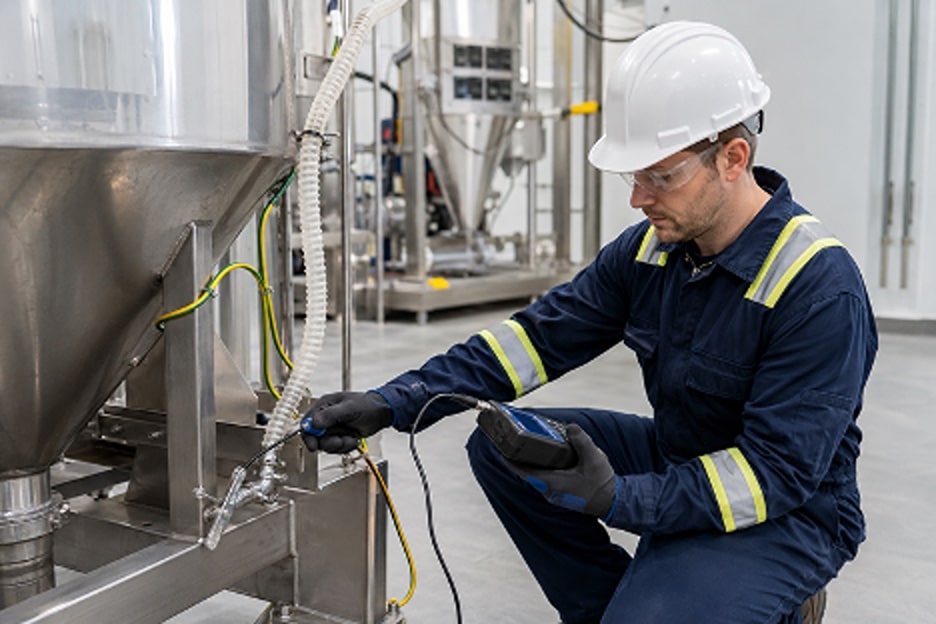
Protect Against Electrostatic Hazards
Understand the conditions that lead to gas and vapor explosions, common industrial scenarios, and how facilities can reduce the risk.
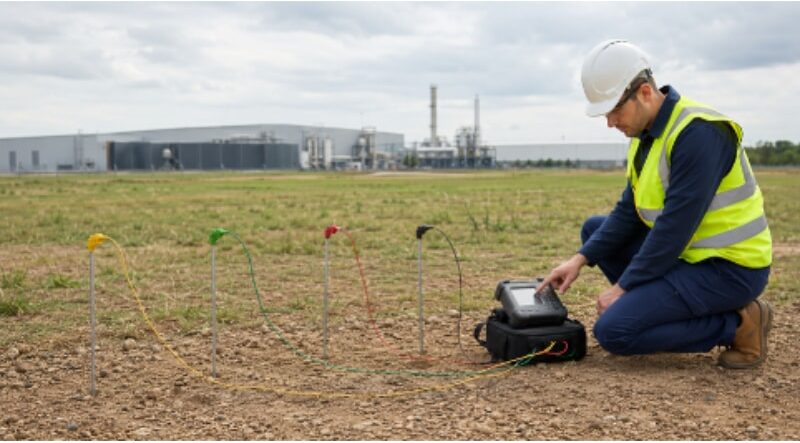
Soil Resistivity Information and Field Testing
Understand the conditions that lead to gas and vapor explosions, common industrial scenarios, and how facilities can reduce the risk.

SDS Creation and Physical Property Testing
Understand the conditions that lead to gas and vapor explosions, common industrial scenarios, and how facilities can reduce the risk.

UN/DOT HAZARDOUS MATERIALS TESTING
Understand the conditions that lead to gas and vapor explosions, common industrial scenarios, and how facilities can reduce the risk.

Thermal Stability Testing
Understand the conditions that lead to gas and vapor explosions, common industrial scenarios, and how facilities can reduce the risk.

Combustible Dust Hazard Identification and the Dust Hazard Analysis (DHA)
Understand the conditions that lead to gas and vapor explosions, common industrial scenarios, and how facilities can reduce the risk.

Chemical Reaction Hazard Testing & Reactive Chemical Services
Understand the conditions that lead to gas and vapor explosions, common industrial scenarios, and how facilities can reduce the risk.