

Table of Contents
- 1. Overview of Electrostatic Risk and Potential
- 2. How Static Electricity Is Generated in Industrial Operations
- 3. When Electrostatic Discharge Becomes a Fire or Explosion Hazard
- 4. Common Warning Signs of an Uncontrolled Static Problem
- 5. What an Electrostatic Hazard Assessment Should Evaluate
- 6. Laboratory Testing: Turning Electrostatic Behavior into Actionable Data
- 7. FIBC and Liner Testing
- 8. Controls Must Match the Actual Charging Mechanism
- 9. Harnessing Electrostatic Potential for Better Processes
- 10. Build Electrostatic Competence Across the Organization
- 11. From Invisible Risk to Measurable Control
- 12. Contact & Consultations
PROCESS SAFETY INSIGHT: Protect Against Electrostatic Hazards—and Harness Electrostatic Potential
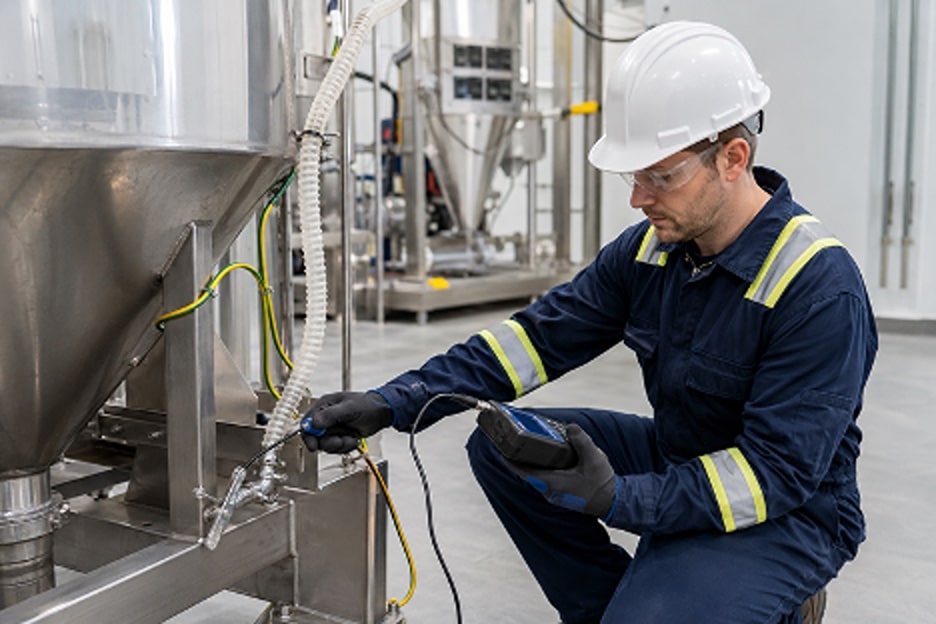
Understanding how static electricity is generated, retained, discharged and controlled is the first step toward safer, more reliable industrial operations.
Electrostatic measurements help verify that conductive equipment has an effective path to ground. Prime Process Safety Center provides electrostatic hazard assessments, on-site measurements, laboratory testing, incident investigations, research and training.
Executive Summary
Static electricity is easy to underestimate. It cannot usually be seen, and the small shock felt after walking across a floor may seem harmless. In industrial operations, however, the same physical phenomenon can accumulate on powders, liquids, equipment, flexible containers, plastic liners, hoses, clothing and personnel. When that charge is released as an electrostatic discharge, it can become an ignition source for a flammable gas, vapor or combustible-dust atmosphere.
Overview of Electrostatic Risk and Potential
Electrostatics are not only a hazard. When properly understood and controlled, electrostatic behavior can also be used to improve material handling, coating, separation, filtration, environmental applications, biotechnology processes and product performance. The objective is therefore broader than simply “removing static.” It is to understand where charge is generated, how it accumulates, how quickly it dissipates, what type of discharge may occur and whether that discharge could ignite the atmosphere or disrupt the process.
Prime Process Safety Center helps organizations answer those questions through electrostatic hazard assessments, laboratory testing, on-site measurements, incident investigations, research and electrostatic hazard training. This integrated approach turns an invisible and often misunderstood phenomenon into measurable information and practical risk-reduction actions.
How Static Electricity Is Generated in Industrial Operations
Static electricity is produced whenever two materials make contact and then separate. During contact, electrons may transfer from one surface to the other. When the materials separate, each may retain an unequal electrical charge. If the charge has no sufficiently conductive path to ground, it can accumulate.
Industrial processes create countless opportunities for contact and separation, including:
- Powders flowing through chutes, pipes, filters, mills, blenders and pneumatic conveying systems
- Low-conductivity liquids flowing through piping, filters, pumps, hoses and spray nozzles
- Filling or emptying drums, tank trucks, vessels and flexible intermediate bulk containers
- Removing plastic film, peeling labels, unwinding webs or separating sheets
- Personnel walking across insulating floors or wearing insulating footwear and clothing
- Product contacting nonconductive hoses, liners, coatings and process equipment
- Spraying, fluidization, agitation, mixing, grinding, sieving and vacuum transfer
Charge generation alone does not establish an ignition hazard. A hazardous event requires several conditions to align: charge must be generated, accumulate on an object or material, and discharge with sufficient energy in the presence of an ignitable atmosphere. A sound assessment examines the complete chain rather than focusing on a single reading or control measure.
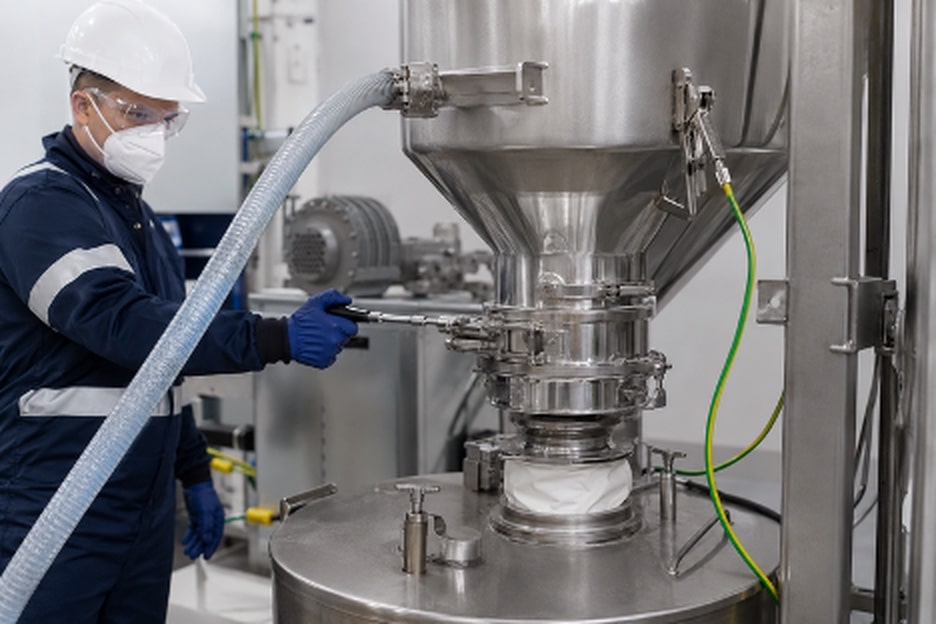
Bonding and grounding should be integrated into powder-transfer equipment and verified as part of routine inspections.
When Electrostatic Discharge Becomes a Fire or Explosion Hazard
Flammable gases and vapors, and combustible dust clouds, can ignite when exposed to an electrostatic discharge whose effective energy exceeds the atmosphere’s ignition sensitivity. For combustible powders, Minimum Ignition Energy (MIE) testing helps determine how readily a dispersed dust cloud may be ignited by an electrical spark. This result is critical because a control strategy suitable for a relatively insensitive material may be inadequate for a low-MIE powder.
The discharge mechanism also matters. Electrostatic discharges can include sparks from isolated conductive objects, brush discharges from charged insulating surfaces, cone or bulk discharges within powders, and energetic propagating brush discharges associated with highly charged insulating layers or surfaces. Each has different formation conditions and ignition capabilities. Consequently, the presence of “grounding” somewhere in the process does not automatically mean the electrostatic risk is controlled.
Required Coincidence for Electrostatic Ignition
+-----------------------------------------------------------+
| 1. A flammable gas, vapor or combustible-dust atmosphere |
|    is present.                                            |
+-----------------------------+-----------------------------+
                              |
                              v
+-----------------------------------------------------------+
| 2. Electrostatic charge is generated and retained.        |
+-----------------------------+-----------------------------+
                              |
                              v
+-----------------------------------------------------------+
| 3. A discharge mechanism capable of transferring energy   |
|    develops.                                              |
+-----------------------------+-----------------------------+
                              |
                              v
+-----------------------------------------------------------+
| 4. The effective discharge energy is sufficient to ignite |
|    the atmosphere.                                        |
+-----------------------------------------------------------+
If ignition-source elimination cannot be demonstrated as reliable, the risk-management strategy may also need to prevent the formation of an ignitable atmosphere or provide appropriate explosion prevention and protection. Electrostatic control should therefore be integrated into a broader process-safety program, including combustible-dust testing, Dust Hazard Analysis (DHA), hazardous area classification, operating procedures and management of change.
Common Warning Signs of an Uncontrolled Static Problem
An electrostatic hazard is not always announced by a visible spark. Facilities should investigate recurring shocks, unexplained fires, pinholes or defects in films and coatings, product clinging, dust attraction, erratic weighing, nuisance instrument behavior, unexpected contamination, or inconsistent transfer and filling performance.
Other indicators include ungrounded or intermittently grounded metal components; conductive carts, vessels or tools isolated by plastic wheels, gaskets or coatings; nonconductive hoses and liners in powder or solvent service; missing or poorly maintained bonding clamps; FIBCs used without verification of their electrostatic classification; and changes in behavior during dry, low-humidity conditions.
Diagnostic Warning
These symptoms deserve a systematic evaluation. Simply adding an ionizer, humidifier or grounding cable without identifying the charging mechanism can relocate the problem, create false confidence or interfere with product quality.
What an Electrostatic Hazard Assessment Should Evaluate
A comprehensive Electrostatic Hazard Assessment follows the material through the process and evaluates both normal and reasonably foreseeable abnormal conditions. The assessment should consider:
- The combustible or flammable properties of powders, gases, vapors and liquids
- Material-transfer rates, splash filling, filtration, spraying, agitation and pneumatic conveying
- Conductive objects that may become electrically isolated
- Powders, liquids and solid surfaces capable of retaining charge
- Hoses, liners, films, coatings, flooring, footwear, clothing and packaging
- Equipment bonding, grounding continuity and resistance to ground
- Personnel charging and the effectiveness of footwear-flooring systems
- Ambient temperature and relative humidity
- Likely discharge types and their ignition capability
- Existing operating, inspection, maintenance and management-of-change practices
On-site measurements can include electrostatic field and voltage measurements, resistance and continuity checks, resistance-to-ground measurements, charge-transfer observations and verification of grounding devices. Results should be interpreted in the context of the material properties and actual operation—not treated as isolated pass/fail numbers.
The final recommendations may involve engineering controls, material substitutions, revised transfer methods, verified bonding and grounding, conductive or static-dissipative equipment, personnel-grounding systems, ionization, humidity management, inspection frequencies, training or explosion-protection measures.
Laboratory Testing: Turning Electrostatic Behavior into Actionable Data
Prime Process Safety Center provides a broad range of electrostatics testing services for powders, liquids, films, sheets, fabrics, foils, coatings, liners, clothing, footwear, flooring and flexible intermediate bulk containers. Testing is selected based on the material, process and hazard question.
Liquid Conductivity
Liquid conductivity testing helps determine how readily charge can dissipate through a liquid. Low-conductivity liquids may retain charge during flow, filtration, mixing and tank filling, particularly when transfer velocities, filters or splash-filling conditions promote charging. Conductivity data can inform transfer procedures, residence time, grounding arrangements and the evaluation of antistatic additives where appropriate.
Surface and Volume Resistivity
Surface resistivity testing evaluates current flow along a material’s surface, while volume resistivity testing evaluates resistance through its bulk. These properties help determine whether a material will conduct, dissipate or retain charge. Applications include powders, films, sheets, liners, fabrics, flooring, coatings and packaging materials. Tests may be conducted in accordance with applicable standards and accepted practices, including ASTM D257, BS 5958 and NFPA 77, as appropriate to the test item and objective.
Charge-Relaxation or Decay Time
Charge-relaxation testing measures how quickly an imposed charge dissipates. This information is valuable when determining whether a material will remain charged long enough to create a handling, ignition, quality or performance problem. It can also support decisions concerning residence time, material selection, earthing and process sequencing.
Electrostatic Discharge and Charge-Transfer Testing
Electrostatic discharge testing evaluates the charge transferred during a discharge from an insulating or charged object. The measured charge transfer can help determine whether the discharge is capable of igniting a relevant flammable atmosphere and whether additional controls are necessary.
Breakdown Voltage and Propagating Brush Discharge Potential
Breakdown voltage testing assesses insulating layers, films, sheets, fabrics, foils, coatings and liners. This is especially important when evaluating whether an insulating layer could support a propagating brush discharge—an energetic discharge capable of igniting many flammable gases, vapors and powders. Applicable methods may include ASTM D3755, IEC 60243-1 and relevant provisions of IEC 61340-4-4.
FIBC and Liner Testing
Flexible intermediate bulk containers are widely used for powders and granules, but their woven polymer construction can generate and retain charge during filling and emptying. FIBC electrostatic testing supports classification and safe-use decisions for Type A, B, C and D containers under IEC 61340-4-4. Depending on the container and intended classification, testing may include resistance to ground, breakdown voltage, surface resistivity and electrostatic discharge testing under controlled temperature and humidity conditions.
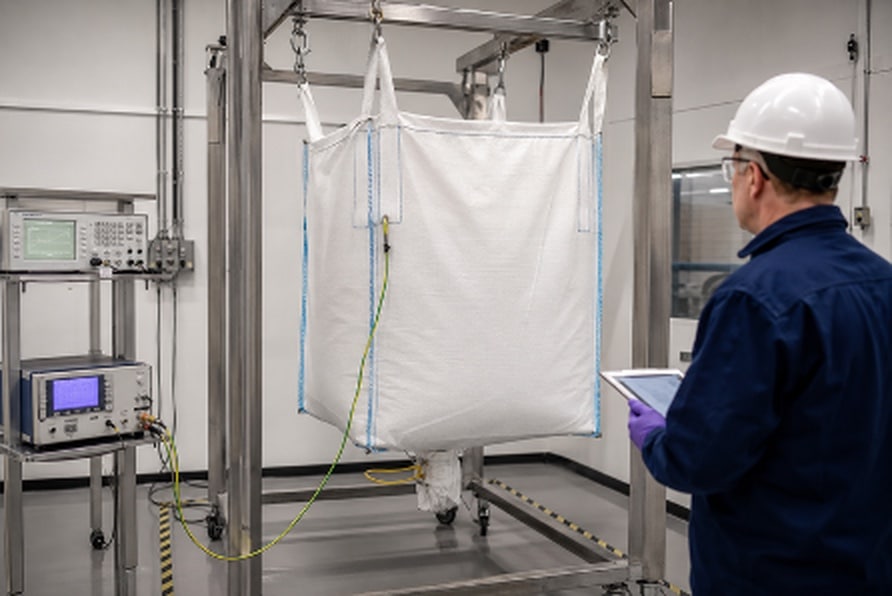
FIBC electrostatic testing supports safe selection and use of Type A, B, C and D bulk containers.
Associated liners also require careful evaluation. Testing may include surface resistivity for Type L1, L2 and L3 liners, as well as breakdown-voltage measurements for multilayer liner constructions. A bag or liner should never be selected solely by appearance or marketing description; its electrostatic performance must be compatible with the powder, surrounding atmosphere, filling system and grounding practices.
Summary of Electrostatic Laboratory Test Methods
| Test Parameter | Applicable Standards | Primary Purpose | Key Operational Benefit |
|---|---|---|---|
| Liquid Conductivity | ASTM D2624 / Standard Methods | Evaluate dissipation rate in flowing liquids | Prevents charge buildup in piping and solvent mixing |
| Surface & Volume Resistivity | ASTM D257, BS 5958, NFPA 77 | Classify materials as conductive, dissipative, or insulating | Guides safe selection of liners, hoses, and flooring |
| Charge Decay Time | Federal Test Method 101C / IEC standards | Measure rate of charge relaxation over time | Determines required residence times before sampling/filling |
| Breakdown Voltage | ASTM D3755, IEC 60243-1 | Determine risk of Propagating Brush Discharge (PBD) | Ensures insulating coatings on metal tanks remain safe |
| FIBC Classification | IEC 61340-4-4 | Certify Type A, B, C, and D bulk bags and liners | Prevents catastrophic dust cloud ignitions during transfer |
Table 1. Overview of standard laboratory tests for industrial electrostatic risk evaluation.

Controls Must Match the Actual Charging Mechanism
Effective electrostatic risk reduction typically uses a hierarchy of compatible controls.
- Bonding and grounding provide conductive equipment and isolated metal objects with a reliable path for charge dissipation. Connections should be designed for the service, protected against corrosion or coating interference, and verified at a risk-based frequency.
- Conductive or static-dissipative materials may replace highly insulating hoses, liners, containers, flooring or components, provided they are correctly installed and grounded where required.
- Personnel grounding may involve suitable footwear and flooring systems, grounding straps or other engineered methods. The complete system must be evaluated; a conductive shoe alone cannot work through an insulating floor.
- Process modification can reduce charge generation by addressing transfer velocity, splash filling, free-fall distance, filtration, agitation, pneumatic conveying or the sequence of operations.
- Ionization or charge neutralization can be useful where insulating materials cannot be grounded. Its effectiveness depends on position, distance, airflow, contamination and maintenance.
- Humidity control may reduce charging for some materials, but it is not universally effective and should not be treated as the sole safeguard unless supported by data and reliable environmental control.
- Atmosphere control and explosion protection may be required when electrostatic ignition cannot be eliminated with adequate confidence. Inerting, ventilation, containment, venting, suppression or isolation must be selected through a process-specific hazard analysis.
Harnessing Electrostatic Potential for Better Processes
The same forces that create unwanted charge can also be applied constructively. Electrostatic attraction, repulsion and separation are used in powder coating, particle classification, air cleaning, filtration, material separation, spraying, printing, biotechnology and environmental processes. Research can also help resolve recurring powder-flow, adhesion, contamination and product-quality problems.
The key is controlled application. A successful innovation program characterizes the material, defines the desired electrostatic effect, identifies unintended discharge paths and demonstrates that the operating envelope remains safe. Prime Process Safety Center supports electrostatic research from initial problem definition and bench-scale testing through process evaluation and control recommendations.
Build Electrostatic Competence Across the Organization
Hardware alone cannot sustain electrostatic safety. Operators need to know why a grounding clamp must be connected before transfer begins. Maintenance personnel must understand how paint, corrosion, replacement gaskets or plastic wheels can isolate conductive equipment. Engineers and procurement teams must know how to specify hoses, liners, FIBCs, flooring and grounding systems. Supervisors must recognize when a process or material change requires reassessment.
Electrostatic hazard training builds this shared understanding. Effective training covers charge generation, accumulation and dissipation; discharge mechanisms; ignition sensitivity; bonding and grounding; personnel charging; inspection and testing; and lessons from real incidents. Training should be tailored to the roles and operations at the facility so employees can apply the principles to actual tasks.
From Invisible Risk to Measurable Control
Static electricity should never be managed by assumption. A complete program connects process observations, on-site measurements, laboratory data and competent engineering judgment. It determines whether a hazardous charge can be produced, where it may accumulate, what discharge could occur, and whether the surrounding atmosphere can be ignited. It then establishes controls that are technically appropriate, maintainable and verifiable.
Prime Process Safety Center offers electrostatic hazard assessments, incident investigations, on-site charge measurements, laboratory testing, control-strategy development, research and training. Whether your concern involves powder conveying, flammable-liquid transfer, FIBCs, insulating liners, flooring, personnel charging, unexplained ignition or product-performance problems, our team can help convert electrostatic uncertainty into actionable decisions.

Related Blogs

How to Prevent Dust Explosions and Meet NFPA 660 Requirements
Understand the conditions that lead to gas and vapor explosions, common industrial scenarios, and how facilities can reduce the risk.

Flammability Testing Services
Understand the conditions that lead to gas and vapor explosions, common industrial scenarios, and how facilities can reduce the risk.

Building a Combustible Dust Safety Program
Understand the conditions that lead to gas and vapor explosions, common industrial scenarios, and how facilities can reduce the risk.

ATEX vs IECEx Hazardous Area Classification
Understand the conditions that lead to gas and vapor explosions, common industrial scenarios, and how facilities can reduce the risk.
Protect Against Electrostatic Hazards
Understand the conditions that lead to gas and vapor explosions, common industrial scenarios, and how facilities can reduce the risk.
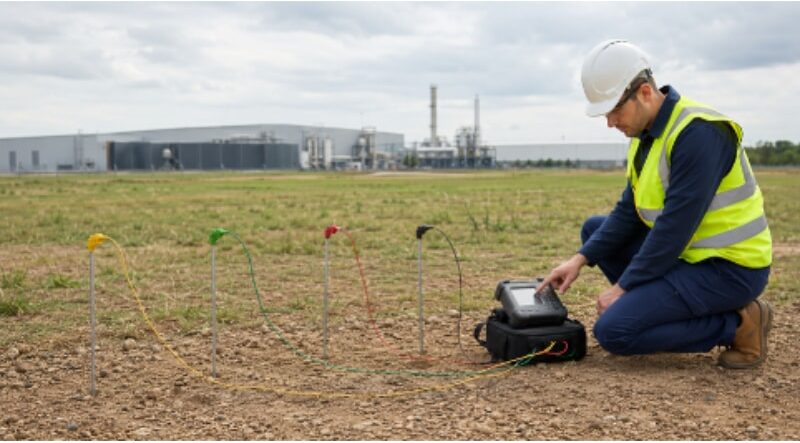
Soil Resistivity Information and Field Testing
Understand the conditions that lead to gas and vapor explosions, common industrial scenarios, and how facilities can reduce the risk.

SDS Creation and Physical Property Testing
Understand the conditions that lead to gas and vapor explosions, common industrial scenarios, and how facilities can reduce the risk.

UN/DOT HAZARDOUS MATERIALS TESTING
Understand the conditions that lead to gas and vapor explosions, common industrial scenarios, and how facilities can reduce the risk.

Thermal Stability Testing
Understand the conditions that lead to gas and vapor explosions, common industrial scenarios, and how facilities can reduce the risk.

Combustible Dust Hazard Identification and the Dust Hazard Analysis (DHA)
Understand the conditions that lead to gas and vapor explosions, common industrial scenarios, and how facilities can reduce the risk.

Chemical Reaction Hazard Testing & Reactive Chemical Services
Understand the conditions that lead to gas and vapor explosions, common industrial scenarios, and how facilities can reduce the risk.

ASTM Testing Services
Understand the conditions that lead to gas and vapor explosions, common industrial scenarios, and how facilities can reduce the risk.