

Quick Navigation — Jump to Section
- 1. Reliable SDS Documentation Starts with Reliable Data
- 2. Why Literature Values Alone May Not Be Enough
- 3. What an SDS Creation Project Can Include
- 4. Physical Property Testing for SDS Preparation
- 5. How Laboratory Data Supports More Than Section 9
- 6. A Practical SDS Data-Gap Review Flowchart
- 7. What to Provide When Requesting a Quote
- 8. Who Benefits from Integrated SDS and Testing Support?
- 9. Why Prime Process Safety Center
- 10. Frequently Asked Questions
LABORATORY TESTING & HAZARD COMMUNICATION: SDS Creation and Physical Property Testing
Laboratory data you can use. SDS documentation you can defend.
Integrated SDS preparation and physical-property testing connect measured product data with clear hazard communication. Source: Prime Process Safety Center

Need help scoping your project?
Prime Process Safety Center can review your existing SDS, formulation information, and data gaps to identify a practical testing and documentation plan. Request a Quote | Call (346) 462-3838
Reliable SDS Documentation Starts with Reliable Data
A Safety Data Sheet is more than a compliance form. It is a working technical document used by employees, customers, emergency responders, transport teams, engineers, and product-stewardship professionals to understand a material and make decisions about its safe use. When the data behind the SDS are incomplete, outdated, inconsistent, or based on a different formulation, the document can create uncertainty precisely where clarity is needed most.
Prime Process Safety Center provides coordinated SDS preparation and laboratory physical-property testing for chemicals, formulations, liquids, powders, solids, intermediates, and specialty materials. The objective is straightforward: identify the information that is already dependable, determine where meaningful gaps remain, select appropriate tests for the material and intended use, and translate the results into technically sound hazard communication.
Under OSHA’s Hazard Communication Standard, chemical manufacturers and importers must evaluate chemical hazards and prepare labels and SDSs for downstream users. OSHA specifies a 16-section SDS format, while Appendix D identifies the information expected in each section, including key physical and chemical properties in Section 9. The appropriate scope still depends on the product, target jurisdiction, intended market, and available evidence.
Related Prime Process Safety resource: Safety Data Sheet (SDS) Creation
Why Literature Values Alone May Not Be Enough
Supplier SDSs, technical databases, and published literature are valuable starting points, but they do not always describe the material actually being sold or processed. A formulation may include solvents, additives, stabilizers, fillers, moisture, particle-size differences, or concentration ranges that materially change its physical behavior. Even where a published value is scientifically credible, it may have been measured under conditions that differ from the current product or the decision at hand.
New or targeted testing should be considered when:
- The current SDS contains blank, obsolete, estimated, or contradictory values.
- A new formulation or developmental material has limited measured information.
- A change in solvent, concentration, additive, or raw material may alter volatility or flammability.
- A customer, insurer, regulator, or engineering team requests measured product-specific data.
- The available value was generated by a method or under conditions that do not fit the present application.
- Scale-up requires dependable data for ventilation, storage, transfer, containment, hazardous area classification, or fire and explosion analysis.
Important Note on Data-Gap Reviews
Not every blank field automatically requires laboratory testing. A defensible data-gap review distinguishes between information that can be supported by reliable evidence, information that is not applicable, and information for which a measured value would materially improve classification or decision-making.

What an SDS Creation Project Can Include
The table below illustrates typical technical scope across the core SDS workstreams:
| SDS Workstream | Typical Technical Scope |
|---|---|
| Product Identification | Product name, recommended use, restrictions on use, responsible-party information, and emergency contact details. |
| Hazard Identification | Evaluation and communication of applicable physical and health hazards based on available evidence and relevant classification criteria. |
| Composition / Ingredients | Chemical identities, CAS information, concentration information, and appropriate handling of confidential business information. |
| Emergency Information | First-aid measures, firefighting information, accidental-release considerations, and suitable response guidance. |
| Handling and Exposure Controls | Storage, handling, engineering controls, exposure information, and personal protective equipment appropriate to the known hazards. |
| Physical and Chemical Properties | Integration of reliable literature values and, where appropriate, laboratory-measured data. |
| Stability and Reactivity | Chemical stability, conditions to avoid, incompatibilities, hazardous reactions, and decomposition products. |
| Transport and Regulatory Information | Available transport and regulatory information within the agreed scope and target jurisdiction. |
Table 1. Overview of typical technical scope in SDS creation.
Physical Property Testing for SDS Preparation
The test program should be selected around the material, the data gap, and the intended decision. The same property can serve several purposes: SDS documentation, hazard classification, product characterization, engineering design, or a broader process-safety study.
Boiling Point or Boiling Range
Boiling-point testing characterizes the temperature, or temperature range, at which a liquid transitions to vapor under specified conditions. For mixtures, the initial boiling point and boiling range may be more informative than a single number. The result can support Section 9, volatility assessment, storage and handling decisions, and interpretation of temperature-dependent vapor generation. Learn more about Boiling Point Testing.
Melting Point or Melting Range
Melting behavior supports the characterization and identification of solids. A pure material may show a relatively sharp transition, while impurities or formulated products can produce a broader range. The information can be relevant to product identity, storage-temperature limits, processing conditions, and SDS Section 9. Learn more about Melting Point Testing.
Vapor Pressure
Vapor pressure quantifies a material’s tendency to enter the vapor phase at a specified temperature. Because the value is temperature-dependent, a useful result must identify the test temperature and method. Vapor-pressure data can influence containment, ventilation, exposure evaluation, emissions estimates, and assessment of whether a flammable atmosphere may form during normal or upset conditions. Learn more about Vapor Pressure Testing.
pH Analysis
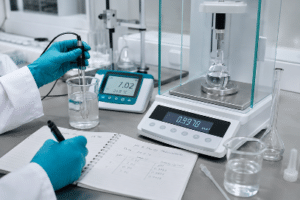
pH testing measures acidity or alkalinity for suitable aqueous materials and defined test conditions. The result can support chemical characterization, compatibility review, handling guidance, and hazard evaluation. pH should not be treated as a stand-alone classification decision: concentration, acid or base reserve, buffering, physical state, and other evidence may also matter. Learn more about pH Analysis.
Density, Relative Density, and Specific Gravity
Density-related measurements describe mass per unit volume or compare a material with a reference substance. These values support Section 9, product characterization, tank and vessel calculations, material transfer, spill behavior, and inventory conversions. Results should clearly state temperature and the property reported so that density and relative density are not used interchangeably. Learn more about Relative Density Testing.
Apparent Bulk Density
Bulk density characterizes how a powder or granular solid occupies volume, including the void space between particles. It is useful for hopper and silo capacity, packaging, conveying, feeder selection, and other material-handling calculations. The result depends on sample condition and procedure, so loose, poured, tapped, or compacted values must be identified accurately.
Flash Point
Flash point is the lowest temperature, under defined test conditions, at which a liquid produces enough vapor to form an ignitable mixture near the liquid surface when an ignition source is applied. It is one of the most important fire-hazard properties for many liquids and formulations. Method selection matters: open-cup and closed-cup procedures do not necessarily produce the same result, and the appropriate method depends on the product and objective. Learn more about Flash Point Testing.
Lower and Upper Flammability Limits (LFL/UFL)
The lower flammability limit is the minimum concentration of a gas or vapor in air that can propagate flame under specified test conditions. The upper flammability limit is the maximum concentration that can do so. Below the LFL the mixture is too lean; above the UFL it is too rich at that location, although mixing with air can move the concentration back into the flammable range. Learn more about Flammability Limit Testing and Gas & Vapor Flammability Testing.
How Laboratory Data Supports More Than Section 9
A measured value is most useful when it is interpreted in context. Physical-property and flammability data can flow into several technical workstreams beyond the SDS itself:
- Fire and explosion evaluation: Flash point, vapor pressure, and flammability limits help characterize whether and when an ignitable vapor atmosphere can form.
- Hazardous area classification: Volatility, release conditions, density, and flammable limits help engineers evaluate potential classified locations and extents.
- Storage and containment: Boiling behavior, density, incompatibility information, and thermal conditions influence vessel, transfer, spill, and ventilation decisions.
- Powder and bulk-solids handling: Bulk density supports capacity and transfer calculations, while combustible-dust properties may be needed when fire or explosion hazards are credible.
- Process scale-up: Dependable data reduce reliance on assumptions when equipment size, operating temperature, pressure, ventilation, or throughput changes.
Explore related services: Testing Capabilities | Combustible Dust Testing | Chemical Compatibility Studies
A Practical SDS Data-Gap Review Flowchart
A data-gap review should begin before samples are submitted. This prevents unnecessary testing and ensures that the selected methods answer the actual question.
- Define the product and market: Confirm the product identity, physical state, composition range, intended use, target jurisdiction, and responsible supplier or importer.
- Review the current evidence: Collect the existing SDS, supplier documents, formulation information, certificates of analysis, technical data, prior test reports, and relevant literature.
- Identify decision-critical gaps: Separate properties that are adequately supported from those that are missing, contradictory, method-sensitive, or not representative of the current formulation.
- Select suitable tests: Choose methods compatible with the sample, expected hazard, concentration range, temperature, and intended classification or engineering decision.
- Generate and review the data: Document sample identity, preparation, method, conditions, observations, limitations, and results. Investigate unexpected or inconsistent findings before they are transferred into the SDS.
- Prepare or revise the SDS: Integrate the evidence across relevant sections so the hazard statements, precautions, properties, stability information, and emergency guidance tell a consistent technical story.
- Control the final document: Confirm revision date, jurisdiction, responsible-party information, language needs, internal approvals, and a process for updating the SDS when significant new information becomes available.
What to Provide When Requesting a Quote
The following information helps Prime Process Safety Center recommend an efficient scope and sample plan:
- Current SDS or draft SDS, if available.
- Product name, physical state, composition, CAS numbers, and concentration ranges.
- Intended use, target market, and applicable jurisdiction.
- Specific missing values, customer questions, or regulatory concerns.
- Expected hazards, handling precautions, temperature sensitivity, or incompatibilities.
- Available literature, supplier data, and previous test reports.
- Requested turnaround time and anticipated sample quantity.
- Whether the data will also support engineering, transport, fire-code, or process-safety work.
Sample Acceptance Requirements
Testing feasibility and sample requirements depend on composition, physical state, expected hazards, method, and requested conditions. Do not ship samples until the laboratory confirms acceptance, packaging, quantity, and shipping instructions.

Who Benefits from Integrated SDS and Testing Support?
- Chemical manufacturers, importers, and distributors.
- Specialty chemical and formulation companies.
- Pharmaceutical, life-science, battery, and energy-material manufacturers.
- Coatings, adhesives, resin, polymer, and plastics manufacturers.
- Powder and bulk-solid processors.
- Food and ingredient manufacturers.
- Contract manufacturers and research organizations.
- Product-stewardship, EHS, quality, engineering, and process-safety teams.
Why Prime Process Safety Center
- One technical team: Coordinate SDS support and applicable laboratory testing through a single point of contact.
- Testing matched to the material: Select tests based on physical state, composition, project objective, expected hazards, and the evidence already available.
- Data interpreted in engineering context: Use physical-property values not only as entries in a document, but as inputs to storage, handling, ventilation, flammability, and process-safety decisions.
- Broader hazard-testing capability: Connect the project, where needed, to gas and vapor flammability, combustible dust, thermal stability, reactive chemical, electrostatic, or compatibility services.
- Clear, defensible documentation: Present the method, conditions, assumptions, limitations, and technical basis needed for review by customers, engineers, EHS teams, and other stakeholders.
Frequently Asked Questions
Can Prime Process Safety Center create a complete SDS?
Prime Process Safety Center can support SDS preparation and revision using product information, composition data, available hazard information, and laboratory data within the agreed scope. The target jurisdiction, language, product use, and responsible-party obligations should be confirmed during scoping.
Can you test a product when the existing SDS has missing properties?
Yes. Provide the current SDS and identify the missing, uncertain, or disputed information. The technical team can help determine which available tests are suitable and which gaps may be addressed through reliable existing evidence.
Do I need to test every Section 9 property?
Not necessarily. The appropriate approach depends on the product, applicable hazard-communication requirements, available reliable information, and the purpose of the SDS. Testing is most valuable when a dependable measured value is needed or current information is absent, inconsistent, or not representative.
Can you test mixtures and formulated products?
Often, yes, but feasibility depends on composition, physical state, expected hazards, requested property, and the suitability of the method. Formulation information should be reviewed before the final test plan and sample requirements are established.
Can the same results support process-safety work?
Yes. Depending on the property and application, measured values can support evaluations involving volatility, fire and explosion hazards, hazardous area classification, storage, material handling, ventilation, and containment.
When should an SDS be updated?
An SDS should be reviewed when significant new hazard or protective information becomes available, when the formulation changes, when new testing changes the technical basis, or when regulatory or market requirements require revision. Under OSHA HCS, significant new hazard or protection information must be added within the required regulatory timeframe.
Related Blogs

SDS Creation and Physical Property Testing
Understand the conditions that lead to gas and vapor explosions, common industrial scenarios, and how facilities can reduce the risk.

UN/DOT HAZARDOUS MATERIALS TESTING
Understand the conditions that lead to gas and vapor explosions, common industrial scenarios, and how facilities can reduce the risk.

Thermal Stability Testing
Understand the conditions that lead to gas and vapor explosions, common industrial scenarios, and how facilities can reduce the risk.

Combustible Dust Hazard Identification and the Dust Hazard Analysis (DHA)
Understand the conditions that lead to gas and vapor explosions, common industrial scenarios, and how facilities can reduce the risk.

Chemical Reaction Hazard Testing & Reactive Chemical Services
Understand the conditions that lead to gas and vapor explosions, common industrial scenarios, and how facilities can reduce the risk.

ASTM Testing Services
Understand the conditions that lead to gas and vapor explosions, common industrial scenarios, and how facilities can reduce the risk.
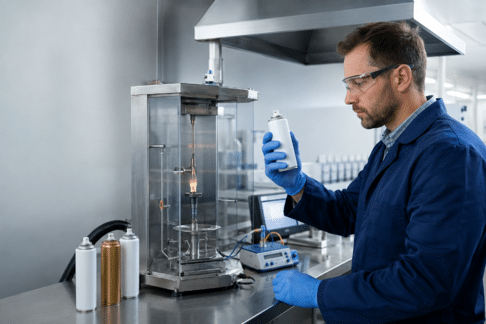
Aerosol Testing Services: Flammability, UN/DOT Classification and Safe Handling
Understand the conditions that lead to gas and vapor explosions, common industrial scenarios, and how facilities can reduce the risk.
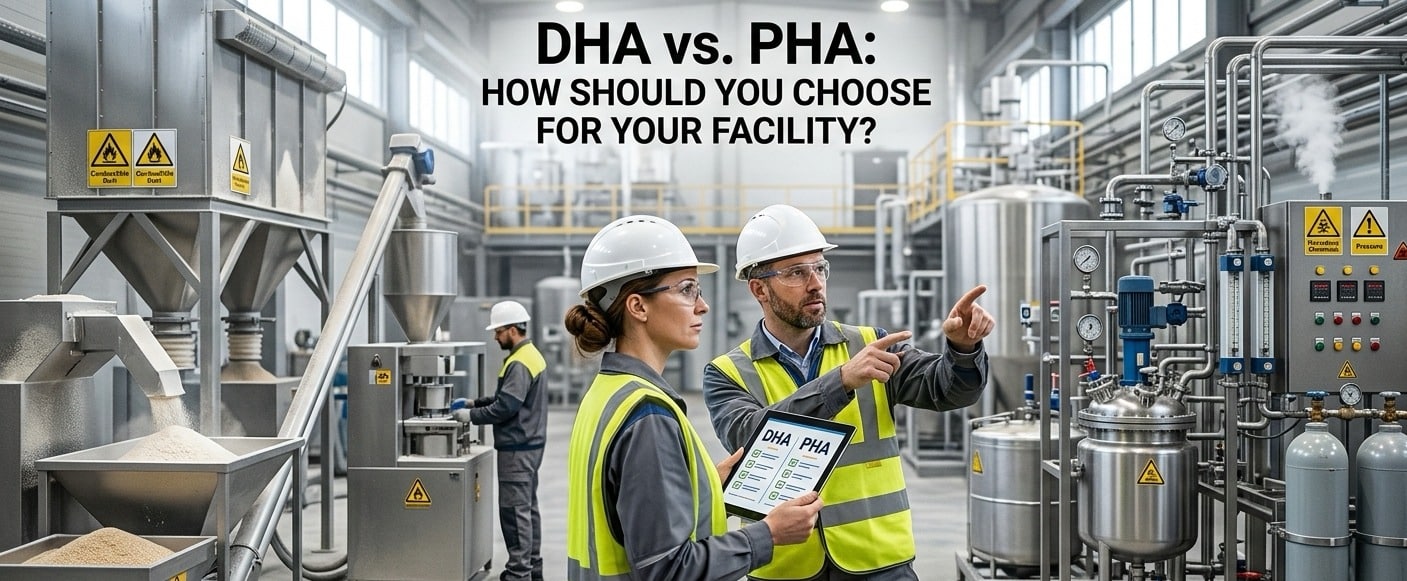
DHA vs. PHA: How Should You Choose for Your Facility?
Understand the conditions that lead to gas and vapor explosions, common industrial scenarios, and how facilities can reduce the risk.

The 0.1% Mistake: How Trace Impurities Trigger Mass Thermal Runaway
Understand the conditions that lead to gas and vapor explosions, common industrial scenarios, and how facilities can reduce the risk.

Understanding the Hidden Dangers of Static Electricity in Plastic Containers and Liners
Understand the conditions that lead to gas and vapor explosions, common industrial scenarios, and how facilities can reduce the risk.

Invisible, Silent, and Costly: The Real Risk of Skipping Static Control
Understand the conditions that lead to gas and vapor explosions, common industrial scenarios, and how facilities can reduce the risk.

Invisible, Silent, and Costly: The Real Risk of Skipping Static Control
Understand the conditions that lead to gas and vapor explosions, common industrial scenarios, and how facilities can reduce the risk.